



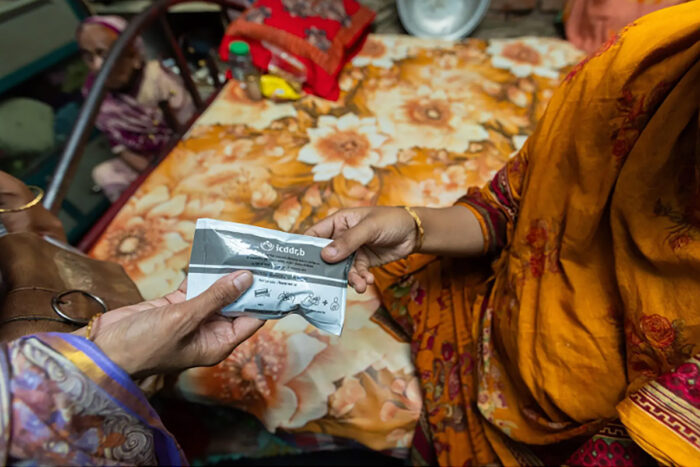
The bold question that led to a TIME Magazine Best Invention of 2025
Photo: Abdullah Al Maymun Chowdhury/icddr,b
As a student, Jeffrey Gordon didn’t aspire to win awards. Instead, he wanted what many young medical scientists want — to do work that changes the world.
While sitting in a lecture on gut cells in his final year of medical school, he had a lightbulb moment: if cells in different regions of the gut produce different products and perform different tasks, how do these cells know where they are in the gut and what they should be doing? And how do they maintain this identity over time? This singular moment would set Gordon on a path to becoming one of WashU Medicine’s most visionary and interdisciplinary scientists recognized on the world stage.
Jeffrey I. Gordon, MD, the Dr. Robert J. Glaser Distinguished University Professor, and his collaborators have transformed our understanding of the gut’s microbial communities and their role in human health and biology. He now co-leads the team that developed a therapeutic food designed to treat childhood malnutrition with his collaborator Tahmeed Ahmed, MBBS, PhD, at the International Centre for Diarrhoeal Disease Research, Bangladesh (icddr,b). The microbiome-directed food has been named one of TIME Magazine’s Best Inventions of 2025.
This therapeutic food, called microbiome-directed complementary food-2 (MDCF-2), is designed to repair the abnormally forming gut microbiomes of children suffering from malnutrition. Clinical trials in Bangladesh have established that the food boosts the activities of gut microbes that play key roles in many facets of growth and development, including effects on proteins that regulate musculoskeletal development, brain development, metabolism and immune function. The benefits produced by MDCF-2 are far greater than those produced by a commonly used therapeutic food that was not designed to repair the microbiome.
Gordon’s team has identified the active compounds in MDCF-2 recognized by gut microbes and how these molecules are transformed, yielding new and deeper understanding of how food is connected to health through the activities of the gut microbiome. The work of the WashU-icddr,b team with MDCF-2 is providing a new perspective on the underpinnings of healthy growth — a perspective that emphasizes the necessity of having a properly choreographed program of co-development of the microbiome and the various organ systems of infants and children.
Clinical trials of the microbiome-directed food, involving nearly 7,000 children of different ages and degrees of malnutrition, are currently underway across sites in South Asia and Africa. The trials are funded by the Gates Foundation and conducted in collaboration with the World Health Organization.
Gordon’s journey stands as a powerful testament that the solutions to our greatest global challenges often begin not with a search for answers, but with the courage to nurture a single, burning question.