
$6.4 million supports studies of cardiac muscle function in heart failure
Two NIH grants fund research into troponin, a key protein involved in heart muscle contractions
 Sara Moser/WashU Medicine
WashU Medicine researchers have received two grants from the NIH to study the roles of troponin — a critical protein in the heart — in various forms of heart failure.
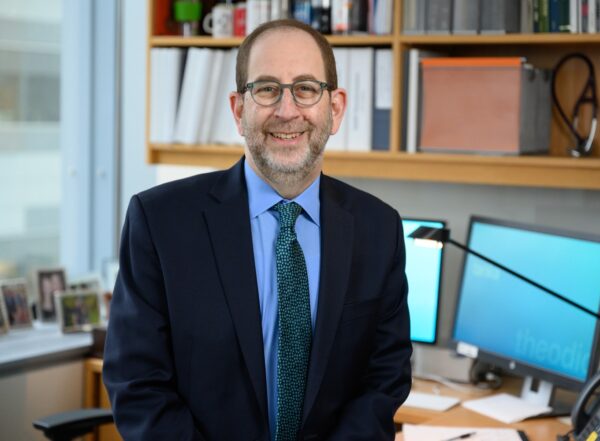
Michael J. Greenberg, PhD, an associate professor of biochemistry and molecular biophysics at Washington University School of Medicine in St. Louis, has received two grants totaling almost $6.4 million to investigate the complex roles of troponin — a critical protein in the heart — in various forms of heart failure. In particular, Greenberg’s research will focus on heart failure caused by genetic variations that lead to changes in troponin’s structure.
Both grants are from the National Heart, Lung, and Blood Institute of the National Institutes of Health (NIH).
“Right now, patients with any form of heart failure receive similar treatments no matter what’s causing it, but these common therapies don’t necessarily help everyone,” Greenberg said. “The goal of the two grants is to help build a framework for precision medicine in treating genetic forms of heart failure, many of which affect the function of troponin. We want to develop targeted treatments that address specific problems with this important protein — similar to the way today’s cancer patients can receive a drug that targets a specific mutation in their tumor.”
Heart failure is a complex condition in which the heart muscle loses its ability to pump sufficient blood to the body. It can have many different causes, from heart muscle damage following a heart attack to viral infection to inherited genetic causes stemming from a wide variety of mutations that scientists are continuing to identify. Studies estimate that perhaps one in 500 individuals have one of these mutations, and it could be as common as one in 250 people, according to Greenberg.
“Only in recent years do we have the technical tools in place to figure out which mutations are causing the heart muscle problems and how they are causing them,” Greenberg said.
Two angles on troponin
With the grants, Greenberg’s team will explore the effects of troponin mutations from two angles. One grant is focused on developing a detailed understanding of the effects of 30 key troponin mutations that are known to cause genetic forms of heart failure. Greenberg and his colleagues have developed multiple model systems including engineered tissues to study these mutations. They will seek to categorize the mutations into distinct groups based on common pathways they affect. They will then analyze whether they can use various drug compounds to reverse the problems in the pathways. Different drugs may be needed for each distinct group, a first step toward developing targeted treatments for inherited forms of heart failure.
Greenberg’s team has been working to develop small molecule compounds that improve contraction forces in heart muscle cells and tissues. The grant will support further studies of these compounds to determine exactly how they improve heart muscle contraction and whether they could form the basis of a new class of therapies for some types of heart failure. Collaborators on this grant include WashU Medicine investigators Kory Lavine, MD, PhD, a professor of medicine in the Cardiovascular Division; Benjamin Garcia, PhD, the Raymond H. Wittcoff Distinguished Professor and head of the Department of Biochemistry and Molecular Biophysics; and Rui Zhang, PhD, an associate professor of biochemistry and molecular biophysics.
The second grant will focus on understanding mutations in troponin called variants of unknown significance, which may or may not affect the structure and function of the protein.
Troponin is a large and complex molecule, and significant portions of it are what are known as “intrinsically disordered regions,” or sections of the protein that don’t have a fixed shape and often harbor variants of unknown significance. Disordered regions of troponin are difficult to study but are likely “hot spots” of disease-causing mutations, according to Greenberg. On this grant, Greenberg is working closely with WashU Medicine co-principal investigators Alex S. Holehouse, PhD, and Andrea Soranno, PhD, both associate professors of biochemistry and molecular biophysics.
“The Holehouse and Soranno labs are leaders in the field of intrinsically disordered proteins, and we have teamed up with them to apply tools they have developed to help us analyze these regions of troponin that have been particularly hard to study,” Greenberg said. “These rigorous tools will help us understand how mutations in these regions may lead to changes in function of the protein.”
Greenberg added that the grants exemplify the type of cross-disciplinary collaboration that WashU Medicine is “absolutely fantastic” at fostering, an attribute that distinguishes it from peer institutions and can lead to breakthroughs for patients that might not otherwise have been made.
“We’re working with other basic scientists as well as clinical cardiology colleagues who treat patients and conduct lab research,” Greenberg said. “My own research has gone in some entirely new directions because of these collaborations. We’re hopeful that the research and collaborations supported by these grants will lead to new understandings of heart failure and better therapies for patients.”