
Chahin, Rohatgi named Loeb Teaching Fellows
Projects will focus on artificial intelligence for student feedback, augmented reality in classroom
 WashU Medicine
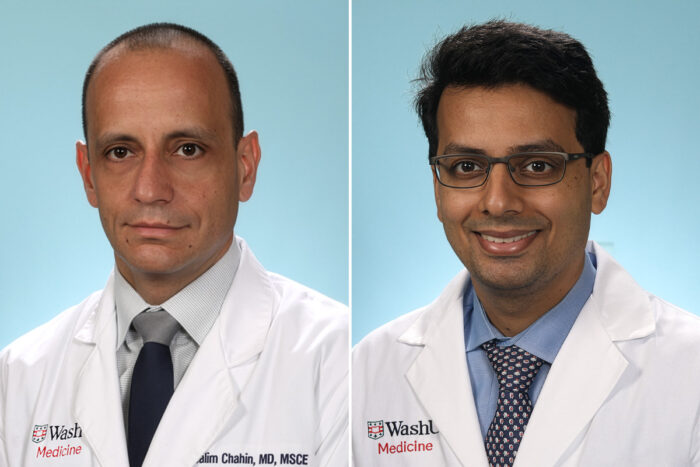
The 2026-28 Carol B. and Jerome T. Loeb Teaching Fellows at WashU Medicine have been named. They are (left) Salim Chahin, MD, an associate professor of neurology, and Ram K. Rohatgi, MD, an assistant professor of pediatrics and of radiology.
Salim Chahin, MD, an associate professor of neurology, and Ram K. Rohatgi, MD, an assistant professor of pediatrics and of radiology, have been named the 2026-28 Carol B. and Jerome T. Loeb Teaching Fellows at WashU Medicine.
A gift from donors Carol B. and Jerome T. Loeb to advance medical education helped to establish the fellowship program. It is also supported by The Foundation for Barnes-Jewish Hospital. The two-year fellowship guarantees focused time to implement innovative ideas to strengthen the education of medical students and residents.
“I have deep gratitude for the Loebs’ generosity and dedication to our faculty, students and residents,” said Eva Aagaard, MD, vice chancellor for medical education, vice dean for education, and the Carol B. and Jerome T. Loeb Professor of Medical Education at WashU Medicine. “Their commitment to training the next generation of physicians and physician-scientists continues to enhance education, research and patient care at WashU Medicine. Their indelible mark on the medical school and the health-care field will live on for decades.”
With his fellowship, Chahin will use artificial intelligence and large language models to develop an efficient, scalable system for generating detailed and quality narratives of medical students’ academic performance. The assessments aim to give students actionable steps to improve their skills while also enabling faculty to customize learning plans based on a student’s needs.
“The project builds on the work of prior Loeb fellows and addresses one of medical education’s most pressing challenges: how to provide each student with the rich, personalized feedback needed to grow while managing the enormous time demand this places on educators,” said Chahin, also associate neurology clerkship director and associate program director of the adult neurology residency. “By developing a machine learning model that generates high-quality narrative assessments, educators can focus on what they do best: coaching students and designing learning experiences tailored to each student’s needs.”
Rohatgi’s fellowship focuses on creating an augmented-reality educational model for teaching cardiac physiology and congenital heart disease to trainees as well as those who care for pediatric heart patients at St. Louis Children’s Hospital. The augmented-reality system will offer learners an immersive experience by using 3D models with animation and the capability to view the heart’s interior. Classroom lessons will allow for real-time discussion, teamwork and immediate instructor feedback.
“Traditional medical education often relies on two-dimensional slide decks or static imaging, but understanding congenital and acquired heart disease is an inherently three-dimensional challenge,” Rohatgi said. “My project addresses this by creating an augmented classroom where learners use virtual reality headsets to explore animated three-dimensional cardiac models together. A flat two-dimensional slide of an opened heart chamber simply cannot match the experience of standing inside an anatomically faithful model. It is the difference between looking at a photograph and taking a field trip.”