
Inaugural WashU Medicine Dean’s Medals honor extraordinary contributions
Eight individuals recognized for their legacy to WashU Medicine, impact on the world
 Gara Lacy
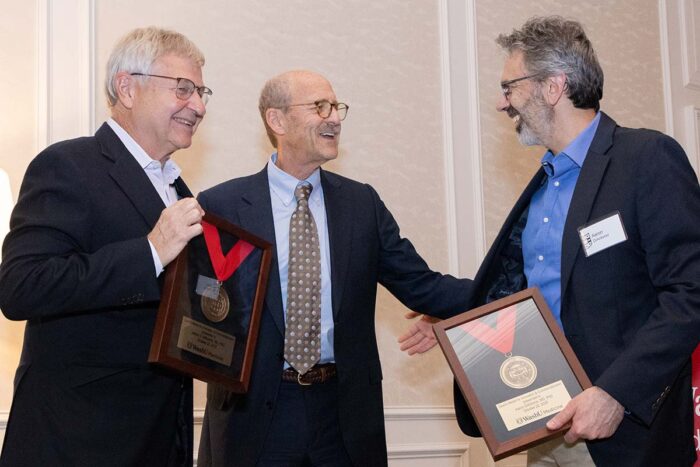
Jeffrey Milbrandt, MD, PhD (left), and Aaron DiAntonio, MD, PhD (right), accept the Dean's Medal for Innovation and Commercialization from David Perlmutter, MD, executive vice chancellor for medical affairs, the Spencer T. and Ann W. Olin Distinguished Professor and the George and Carol Bauer Dean of WashU Medicine. Milbrandt and DiAntonio were among eight individuals who were recognized for their enduring impact on WashU Medicine and beyond.
Leaders across WashU Medicine foster a culture of ambition and achievement that improves the health of the region, the nation and the world. Some of these contributions leave such an indelible mark — advancing the institution’s mission in extraordinary ways — that they merit special recognition.
To honor such achievements — and the donors whose generosity makes them possible — David H. Perlmutter, MD, executive vice chancellor for medical affairs, the Spencer T. and Ann W. Olin Distinguished Professor and the George and Carol Bauer Dean of WashU Medicine, established a new award this year: the WashU Medicine Dean’s Medals.
“The Dean’s Medals were created to recognize extraordinary contributions that advance our mission — from those who treat patients and push the frontiers of science, to those who help lead the education and training of the next generation of physicians, to those whose advocacy and giving spirit shape the future of this institution,” Perlmutter said.
“Those receiving this honor are the ones who continually set that bar, who create and perpetuate and power our environment of never resting on laurels and always pushing forward.”
The following individuals received this prestigious award: Longtime WashU Medicine benefactors Debra and George Couch for leadership and service; Tasnim A. Najaf, MD, for clinical excellence; Eva Aagaard, MD, for education; Robert Schreiber, PhD, and Joan Luby, MD, for research; and Jeffrey Milbrandt, MD, PhD, and Aaron DiAntonio, MD, PhD, for innovation and commercialization.
Renée Shellhaas, MD, senior associate dean for faculty promotions and career development, and her team oversaw the awards process. “Congratulations to our outstanding recipients,” said Shellhaas, also the David T. Blasingame Professor of Neurology. “These medals celebrate remarkable people who lead with vision and courage — advancing discovery, elevating patient care, inspiring learners and driving innovation — all of which make WashU Medicine and our campus community truly exceptional.”
2025 WashU Medicine Dean’s Medal recipients
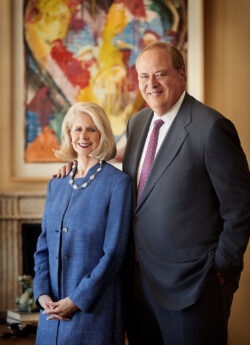
Debra and George Couch received the Dean’s Medal for Leadership and Service for their enduring financial support to Washington University and the research at WashU Medicine over the past four decades.
George Couch’s journey with WashU Medicine began in a deeply personal way. After his younger brother Gregory, who had dreamed of becoming a doctor, passed away unexpectedly in the 1980s, George and his family established the Gregory B. Couch Professorship in Psychiatry. That act of generosity set the stage for a lifetime of impact, touching countless patients and advancing WashU Medicine’s mission.
The Couches have continued to invest in the future of medicine locally, nationally and internationally. The Debra and George W. Couch III Biomedical Research Building — a hub for personalized medicine and discovery — stands as a testament to their ongoing commitment to giving, and they have been supporters of collaborative, interdisciplinary research within the building and across the university.
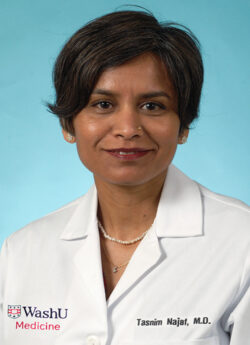
Tasnim Najaf, MD, a professor of pediatrics, received the Dean’s Medal for Clinical Excellence for developing three groundbreaking programs to improve care for young patients at St. Louis Children’s Hospital.
Najaf specializes in the care of critically ill newborns. As the medical director of the NICU extracorporeal membrane oxygenation (ECMO) program — which provides support to infants with critical heart and lung conditions — she leads a team of experts in ECMO, congenital diaphragmatic hernia and pulmonary hypertension. In addition, she has played an integral role in the Neonatal Renal Replacement Therapy Program, which provides lifesaving dialysis to infants. Najaf also helped implement the neonatal point of care ultrasound, which equips learners with bedside diagnostic and procedural ultrasound skills to diagnose various respiratory, cardiac and neurological conditions. These efforts have significantly improved outcomes for seriously ill babies.
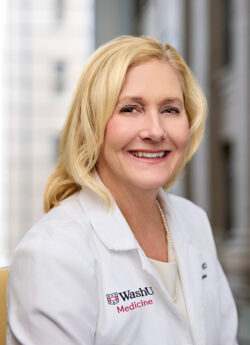
Eva Aagaard, MD, the Carol B. and Jerome T. Loeb Professor of Medical Education, vice dean for education and vice chancellor for medical education, received the Dean’s Medal for Education for her visionary leadership in the development and implementation of the School of Medicine’s Gateway Curriculum.
Nationally known for her leadership in medical education, Aagaard re-envisioned the school’s MD educational program for the first time in more than two decades. Applying both personal and professional insights, Aagaard led the development of the Gateway Curriculum, which launched in 2020. The curriculum has increased learners’ awareness of health disparities, strengthened community engagement in the region and introduced more hands-on clinical experiences in the first two years of the MD program. She also oversees the school’s graduate medical education, allied health programs and PhD training programs. With Aagaard at the helm, WashU Medicine sets the standard as a world leader in medical education.
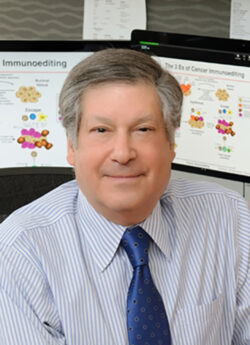
Robert Schreiber, PhD, the Andrew M. and Jane M. Bursky Distinguished Professor of Pathology & Immunology, received a Dean’s Medal for Research Excellence for his groundbreaking discoveries of the biological underpinnings of immune responses to cancer.
Cancer treatment once only consisted of surgery, radiation or chemotherapy. In recent years, more precise alternatives have emerged, thanks in large part to Schreiber’s internationally recognized pioneering research in cancer immunoediting. Schreiber serves as the founding director of the Bursky Center for Human Immunology & Immunotherapy, which translates human immunology research from the bench to the bedside. After helping unlock vital discoveries in how cancer evades the immune system, he went on to identify targets for immunotherapies. His ongoing work with cancer vaccines and immune-based treatments portends even greater impact for cancer patients in the future.
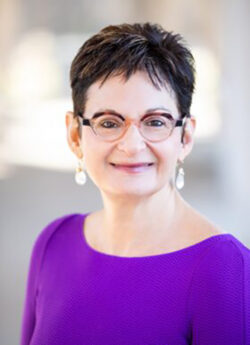
Joan Luby, MD, the Samuel and Mae S. Ludwig Chair in Psychiatry, received a Dean’s Medal for Research Excellence for her pioneering intervention to treat depression in early childhood as founder and director of the WashU Medicine Early Emotional Development Program.
Growing evidence underscores the mental health crisis taking place among children and adolescents across the country. Luby’s large-scale, internationally recognized studies have expanded the field’s understanding of the earliest manifestations of anxiety and depression and demonstrated that infants and children who struggle with emotions and behavior as early as age 3 are more vulnerable to depression and suicide later in life. In an effort to reverse this trend, her groundbreaking research continues to shed light on the importance of early identification and dyadic interventions that empower patients and their parents alike. Her novel early childhood parent-child psychotherapy approach has proven to yield dramatically improved outcomes for children that sustain into preadolescence.
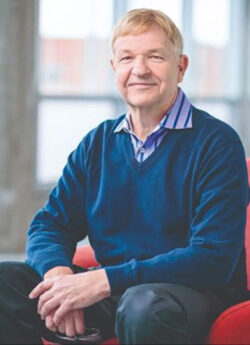
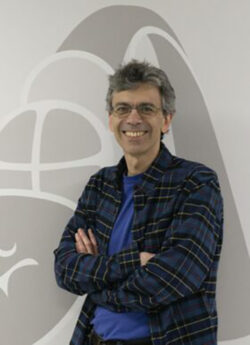
Jeff Milbrandt, MD, PhD, the James S. McDonnell Professor of Genetics and executive director of the McDonnell Genome Institute, and Aaron DiAntonio, MD, PhD, the Alan A. and Edith L. Wolff Professor of Developmental Biology, received the Dean’s Medal for Innovation and Commercialization for their high-caliber scientific research and commercialization achievements.
Most neurodegenerative diseases such as ALS and peripheral neuropathy involve the early loss of axons — the fibers in the nervous system that are responsible for zapping electrical signals from one nerve cell to another. Blending Milbrandt’s research into the genomic and metabolic underpinnings of axon degeneration with DiAntonio’s research into the molecular mechanisms that control neural circuitry led to a surprising discovery: A molecule called SARM1 is responsible for the degeneration of axons. They showed this protein is an enzyme and that inhibiting this activity blocked axon loss and prevented disease. In short, their research uncovered the common molecular culprit found in most neurological disorders.
Working with WashU’s Office of Technology Management, the duo went on to found Disarm Therapeutics, where they developed therapies to inhibit the SARM1 pathway. In 2020, Eli Lilly and Company acquired Disarm Therapeutics for $135 million to speed development of new treatments for multiple neurodegenerative conditions. Milbrandt and DiAntonio have gone on to found several additional companies that focus on translating their research discoveries into therapeutic strategies to address unmet medical needs in neurodegenerative diseases. Their collaborative spirit exemplifies how WashU Medicine researchers can take a basic science discovery and transform it into a therapeutic advance that may one day help millions.
“Each of these honorees represents the very best of who we are and who we wish to be here at WashU Medicine,” Perlmutter said. “They embody the vision, the talent and the generosity of spirit that keep us at the forefront of medicine, science and education. Since this first Dean’s Medal ceremony is also my last as head of this exceptional institution, let me just say that I have considered it a great privilege to lead such an extraordinary group, and I look forward to watching from the sidelines as you soar to even greater heights.”