

Method spots early signs of infection after breast cancer reconstruction
Rapid detection, treatment of infections could avoid complications, additional surgeries after mastectomy
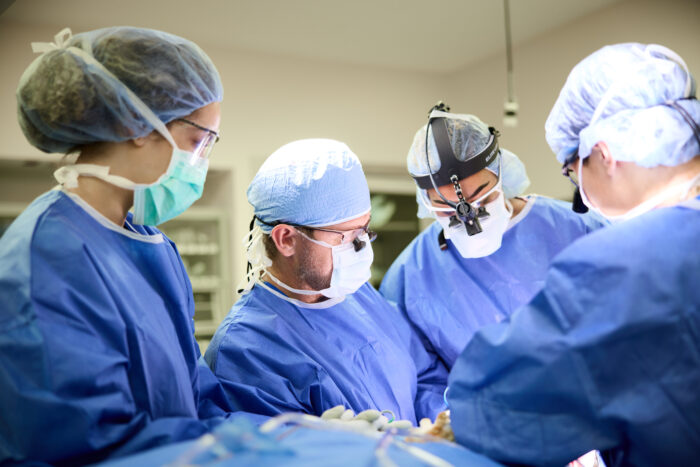 Matt Miller/WashU Medicine
Collaborators at WashU Medicine developed a tool to detect infections early among patients who have had breast reconstruction after cancer, potentially allowing for preemptive treatment that preserves implants, improves outcomes and reduces the emotional and financial burden on patients.
In the U.S., one in eight women will get breast cancer in their lifetime, and about half of them will have mastectomies. Many of those women opt to have their breasts surgically reconstructed, most commonly with implants, but a relatively high percentage develop infections after implant surgery, requiring intravenous antibiotics and often removal of the implant. This can lead to additional surgeries, delays in cancer care and increased costs, as well as added emotional distress for women already under strain from cancer diagnosis and treatment.
To address this problem, researchers at Washington University School of Medicine in St. Louis have developed a new tool to detect reconstruction-related infections early, before they cause symptoms. This could allow for preemptive treatment that preserves implants, improves patient outcomes and reduces the psychological and financial burden on patients.
Led by Jeffrey P. Henderson, MD, PhD, a professor in the WashU Medicine John T. Milliken Department of Medicine, the study identified biomarkers of infection in fluid drained from reconstruction patients’ breasts days or even weeks before symptoms appeared. This represents a major opportunity for improvement over existing diagnostic methods, which rely heavily on clinical symptoms, such as redness and inflammation, that take time to appear and can overlap with normal reactions to surgery.
The findings are available online and will publish in print Feb. 16 in the Journal of Clinical Investigation.
“The ability to identify with a molecular signature early on that a patient will go on to have an infection opens up the possibility of surveillance as part of standard care,” Henderson said. “This has the potential to enable earlier treatment that would be far more effective — and potentially curative — in patients who would otherwise progress to prolonged courses of treatment and surgery, or even implant removal and reconstructive failure.”
Small molecules, big impact
The study originated when Henderson’s WashU Medicine colleague Margaret A. Olsen, PhD, a retired professor of medicine in the Division of Infectious Diseases who studies hospital infections, noticed high rates of infection among U.S. patients who had reconstruction with implants after mastectomy. The discovery prompted Henderson and Olsen, a coauthor on the study, to ask WashU Medicine plastic surgeons who performed breast reconstruction what they would need to improve outcomes in these patients. Their answer was simple: a clear yes/no test for infection.
To develop such a test, Henderson and lead author John A. Wildenthal, an MD/PhD student in WashU Medicine’s Medical Scientist Training Program, leveraged their expertise in metabolomics, the study of small molecules called metabolites that are created or broken down during cellular processes in the body. Metabolites can indicate the presence of an infection because they include byproducts of both the body’s response to pathogens and the metabolic activity of the pathogens themselves. By analyzing changes in metabolite levels, scientists can identify patterns that are characteristic of infections, enabling early diagnosis.
Henderson and colleagues coordinated with WashU Medicine plastic surgeons to obtain fluid samples from 50 patient volunteers during several routine follow-up visits after surgery. The patients included women who later developed infections after post-mastectomy reconstruction and those who did not.
The researchers analyzed the samples for differences between the two groups and identified metabolites that were significantly associated with infection and that appeared days to weeks before clinical signs and symptoms of infection. Further, they found that the presence of certain metabolites indicated more serious infections that might require more aggressive treatment.
“Originating from clinical intuition and validated through a clinical study, the evidence in this paper now supports proactive, targeted interventions to predict and address infections before they become clinically significant,” said Justin M. Sacks, MD, the Sydney M. Shoenberg Jr. and Robert H. Shoenberg Endowed Chair in Plastic and Reconstructive Surgery, director of the Division of Plastic and Reconstructive Surgery at WashU Medicine and a coauthor on the paper. “Such interventions can substantially reduce the burden of complications, implant loss and reconstructive failures in these patients.”
For instance, the findings could lead to the development of a point-of-care test that could be provided during a woman’s routine post-operative visits, noted coauthor Terence M. Myckatyn, MD, a professor of surgery at WashU Medicine, who performs plastic and reconstructive surgery for breast cancer patients.
“If the test is positive, antibiotics can be started preemptively in these select patients to thwart infection,” Myckatyn said. “And perhaps just as important, we would not give antibiotics to those with a negative test, thereby adhering to a thoughtful approach for antibiotic stewardship.” Such careful use of antibiotics is important for preventing antibiotic resistance, he said.
In the near term, the team is planning additional studies to validate the results. Then a diagnostic tool could be developed and tested in clinical practice. In the future, the broader metabolomic findings about the development of tissue infection in humans could allow physicians to more selectively target a variety of post-surgical infections, for example, by revealing new drug targets.
“While better techniques are always being sought, the reality is that infections still occur despite a meticulous surgical approach,” said Myckatyn. “To be able to identify biomarkers that can portend an infection days before it develops is huge.”