
New WashU Medicine initiative aims to strengthen staff culture, support
Staff Climate and Culture Advisory Committee begins work to enhance employee experience
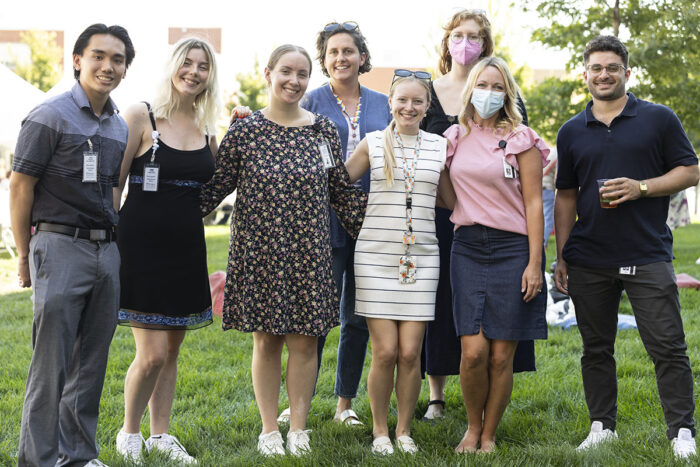 Jerry Naunheim Jr.
Staff members attend the WashU Medicine Staff Appreciation Lunch on Sept. 19, 2024, on Couch Lawn.
WashU Medicine is launching a new initiative to foster a workplace where every staff member feels valued, respected and empowered. The Staff Climate and Culture Initiative comes at a pivotal time, as medical schools and health-care organizations nationwide face mounting pressures from workforce shortages and rapid industry shifts that can impact employee well-being. This effort seeks to address those challenges by investing in the people who play essential roles in advancing WashU Medicine’s missions in patient care, research and teaching.
“The well-being and success of our staff is critical to everything we do — from providing exceptional patient care and conducting groundbreaking research to teaching the next generation of medical and scientific leaders,” said David H. Perlmutter, MD, executive vice chancellor for medical affairs, the Spencer T. and Ann W. Olin Distinguished Professor and the George and Carol Bauer Dean of WashU Medicine. “This initiative will guide us in sustaining an even more positive workplace environment and in realizing our aspiration that everyone on our staff feels valued, supported and heard.”
Spearheading this work is the newly formed WashU Medicine Staff Climate and Culture Advisory Committee, which is chaired by Melissa Rockwell-Hopkins, associate vice chancellor and associate dean of operations and facilities management, and co-chaired by Jessie Cooper, preclinical business director of the McDonnell Genome Institute.
 WashU Medicine
The committee is tasked with identifying strategies to strengthen organizational culture and increase staff engagement by creating a scalable program that will enhance workplace climate and culture and establish a set of core leadership values and management practices that will support an environment where all employees can feel valued, respected and welcome.
A positive work culture is more than just a laudable goal. Research indicates that engaged employees are three times more likely to remain with their organizations, and long-term career satisfaction can contribute to institutional resilience.
“Our people are the foundation of our success, and this initiative is an essential step toward strengthening the culture that supports them,” said Richard J. Stanton, vice chancellor for medical finance and administration. “It will challenge us to find more effective ways to engage and support staff.”
The initiative yields yet another important benefit: Staff members who feel engaged, informed and supported can more meaningfully connect to WashU Medicine’s mission.
Building on the model set forth by WashU Medicine’s Executive Faculty Task Force on Climate and Culture, the Staff Climate and Culture Advisory Committee will meet regularly over the next year, following a phased approach to develop a sustainable, scalable framework aimed at enhancing staff experience, improving retention and strengthening workplace culture. Throughout this process, staff will be invited to actively participate and provide feedback to help shape the outcomes.
“One of our greatest strengths as employees is our commitment to collaboration and teamwork, which drives innovation and success across health care, research and education,” said Rockwell-Hopkins. “By building on this foundation through open two-way communication, engagement and inclusivity, we are able to create a more supportive environment where everyone can thrive personally and professionally.”
Other members of the committee are:
- Caroline Arbanas, assistant vice chancellor for Medical Campus communications, WashU Medicine Marketing & Communications
- Anne DeSchryver, executive business director, Department of Anesthesiology
- Barry Guild, executive business director, Department of Neurology
- Michelle Lewis, director of transportation, parking and administration, WashU Medicine Operations & Facilities Management Department
- Lacey Luitjohan, director of continuous improvement, WashU Medicine Operations & Facilities Management Department
- Olga Kipnis, assistant dean of organization excellence
- Kevin Ko, executive business director, John F. Hardesty, MD, Department of Ophthalmology and Visual Sciences
- Katherine Krajcovic, executive business director, Department of Pediatrics
- Andrea Krussel, director of education and workforce development, Office of Health Information and Data Science
- Stephanie Maples, project manager for planning, WashU Medicine Operations & Facilities Management Department
- Jody Mitori, executive director of strategic communications, WashU Medicine Marketing & Communications
- Cami Spampani, executive director, Division of Biology & Biomedical Sciences
More information about the initiative is available on the WashU Medicine Staff Climate and Culture website and will be updated as the committee’s work progresses.