
New WashU Medicine program to train data specialists to solve real-world problems
Master’s program in biomedical data science and AI offers part-time option and hands-on research experience
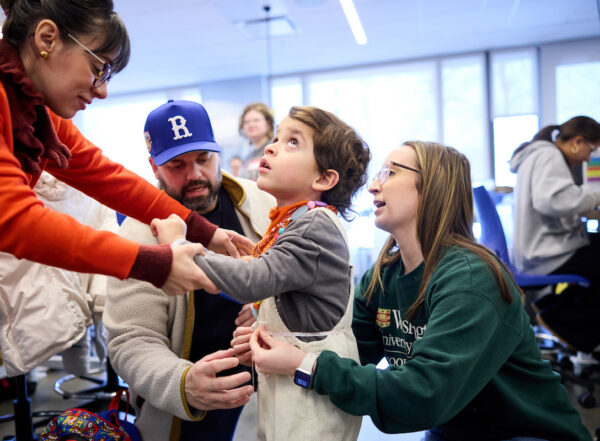
 Matt Miller/WashU Medicine
WashU Medicine’s new master’s program in biomedical data science and AI is designed to meet the growing demand for expertise in biostatistics, data science and biomedical informatics. Here, a student creates computational models from COVID-19 data.
WashU Medicine’s Institute for Informatics, Data Science and Biostatistics (I2DB) is offering a new, more flexible program designed to meet the changing needs of the health and data science fields. The new master’s program in biomedical data science and AI (BDS-AI) — one of few such programs in the U.S. — began accepting applications for full-time students in December and is accepting applications for part-time enrollees until July 15.
The new BDS-AI master’s program offers biostatistics, data science and biomedical informatics as concentrations in a single degree program. It replaces the previous separate master’s programs in biostatistics, biostatistics and data science, and biomedical informatics to address the growing importance of AI in health care.
Po-Yin Yen, PhD, I2DB’s deputy director for education, says the program design allows students to pursue one of three concentrations and choose elective courses from the other two disciplines.
“The new BDS-AI master’s program will equip students with versatile skills that are applicable across a wide range of career pathways,” said Yen. “We want to train students to use AI tools and interdisciplinary skills increasing in demand for health care and health decision making.”
The flexibility in curriculum, along with part-time enrollment and evening class scheduling options, is designed to accommodate working students like Gabriel Kettering, who recently completed his master’s in biomedical informatics through I2DB.
“I had been working in the chemistry field, but I wanted to do something that was more health-focused where I could apply my statistics background,” said Kettering. “The biomedical informatics program at I2DB really combined those two interests, and the scheduling allowed me to remain in my job while getting my master’s degree.”
I2DB’s programs have historically attracted a variety of students — some straight from undergraduate degrees, others who work in health care or other fields and want to upgrade their skills. The labor needs for these students are going to be particularly acute in health care, and specialized training is critical, according to Philip R.O. Payne, PhD, director of I2DB and the Janet and Bernard Becker Professor at WashU Medicine.
The U.S. Bureau of Labor Statistics projects enormous increases in employment opportunities in data science, information engineering and health information technology in the next decade, and those jobs are increasingly demanding flexible skill sets.
“We are training people who are going to help us to deliver better care here in the St. Louis region,” said Payne, who is also the vice chancellor for biomedical informatics and data science at WashU Medicine. “We have a long history of people coming from WashU Medicine programs who step into research, clinical and policy leadership positions, and this program will develop the next set of leaders who will drive that agenda at a national level.”
I2DB master’s program graduates have a high success rate in finding employment in their chosen field, according to Zachary Abrams, PhD, the director of the BDS-AI master’s program who oversaw much of the restructuring of the curriculum. That success stems from the program’s mentored or independent research project component in which students work with the lab of a WashU Medicine scientist. This element is being consciously integrated into the BDS-AI coursework to reflect how these technologies are being applied in the health sciences workplace.
“The research at WashU Medicine can advance scientific discoveries, and our master’s students have the opportunity to receive hands-on experience with our faculty, working on a real project with real data. That collaboration is a unique strength of our program,” said Abrams.
Kettering spoke highly of his mentored research project in the lab of Dustin M. Baldridge, MD, PhD, an assistant professor of pediatrics, genetics and genomic medicine. Kettering and his labmates looked for genetic variants in enormous datasets that could identify rare and undiagnosed medical conditions.
“I’ve been working on projects similar to what I will be seeing in my health-care career, and I’m also developing connections in my lab and with our collaborators,” said Kettering, who hopes to work in computational genetic analysis in the pharmaceutical industry. “The faculty here are nothing short of incredible — I always felt that they were there for me and that WashU Medicine was helping me succeed.”