
Obituary: Steven L. Teitelbaum, professor of pathology and immunology, 87
Renowned as one of the world’s leading experts in bone metabolism
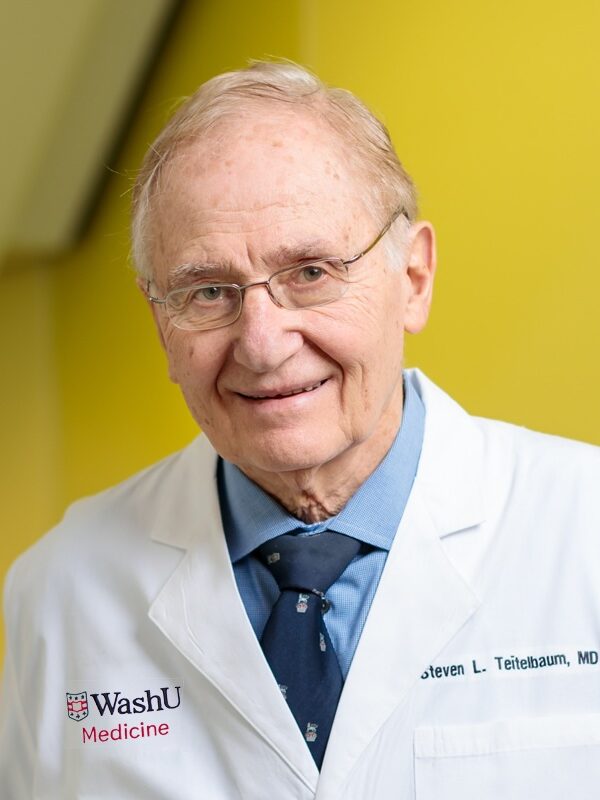
Teitelbaum
Steven L. Teitelbaum, MD, a nationally recognized leader in bone biology research at WashU Medicine, died Monday, Dec. 15, 2025, in St. Louis after suffering an intracranial hemorrhage. He was 87.
Teitelbaum was the Wilma and Roswell Messing Professor of Pathology & Immunology and professor of medicine in the WashU Medicine Division of Bone & Mineral Diseases. A highly accomplished and respected physician-scientist, he studied the balance between the cells that build up bone — the osteoblasts — and those that break it down — the osteoclasts. In particular, he studied what happens when osteoclasts are the more active of the two, leading to the development of therapies for bone-related conditions such as osteoporosis and rheumatoid arthritis.
“Steve leaves behind a legacy of distinguished scholarship and outstanding service to the community of WashU Medicine,” said Eric J. Huang, MD, PhD, the Joseph M. Davie Distinguished Professor and head of the Department of Pathology & Immunology. “Most impressively, Steve was a prolific and highly regarded mentor who cultivated generations of trainees, many of whom became leaders in their own fields. His infectious enthusiasm and warm personality enlightened many bright minds.”
In the late 1970s, Teitelbaum developed a method to diagnose bone disorders and studied the role of vitamin D to overcome defective bone formation. Since the 1980s, his work helped explain early development and functions of osteoclasts. More recently, his pioneering research focused on the interactions between bone, fat and energy metabolism, resulting in the discovery that fat cells release compounds that increase bone production. He helped explain why people with Type 2 diabetes — a disease strongly linked to obesity — tend to get bone fractures if they are treated with a class of drugs called glitazones. He showed that a different family of drugs could effectively treat Type 2 diabetes without the risk of fractures.
Teitelbaum published over 340 scientific papers and over 50 books and book chapters. He was a member of the editorial boards of several journals, including Cell Metabolism and Experimental Medicine. Teitelbaum received many awards honoring his outstanding contributions to science, including the prestigious King Faisal International Prize in Medicine, which recognized his research for its major benefit to humanity, and the Rous-Whipple Award by the American Society for Investigative Pathology. A natural leader, he served as president of the American Society for Bone and Mineral Research and Federation of American Societies for Experimental Biology, among many other leadership roles.
A native of Brooklyn, New York, Teitelbaum attended Columbia College at Columbia University in New York City, where he earned a bachelor’s degree. He earned his medical degree from WashU Medicine in 1964 before completing his clinical training at WashU Medicine and New York University. He returned to WashU Medicine in 1968 as a clinical fellow in pathology and joined the faculty in 1969. Teitelbaum served as chair of the Department of Pathology of Jewish Hospital from 1987 to 1996.
Teitelbaum is survived by his brother, Herb Teitelbaum; sister-in-law, Ruth Abram; children, Caren and Aaron Teitelbaum, and Rebecca Wallace; son-in-law, Jon Wallace; daughter-in-law, Marci Teitelbaum; and grandchildren, Samuel and Leo Wallace, and Quinn Teitelbaum; and several nieces, nephews, grandnieces and grandnephews. He was twice widowed, first by his wife Eve Sternberg Teitelbaum and then by his wife of more than 50 years, Marilyn Schaffner Teitelbaum.
A celebration of Teitelbaum’s life will be announced at a later date. Memorial tributes may be made to the St. Louis Public School Foundation, noting the “Steve Teitelbaum Collegiate School of Medicine and Bioscience Fund, Account 1690” and addressed to The St. Louis Public School Foundation, 801 N. 11th Street, St. Louis, MO 63101.
Read more in the obituary in the Post-Dispatch.