
Obituary: Stuart A. Kornfeld, professor emeritus of medicine, 88
Renowned hematologist pioneered field of glycobiology, made significant contributions to physician-scientist training
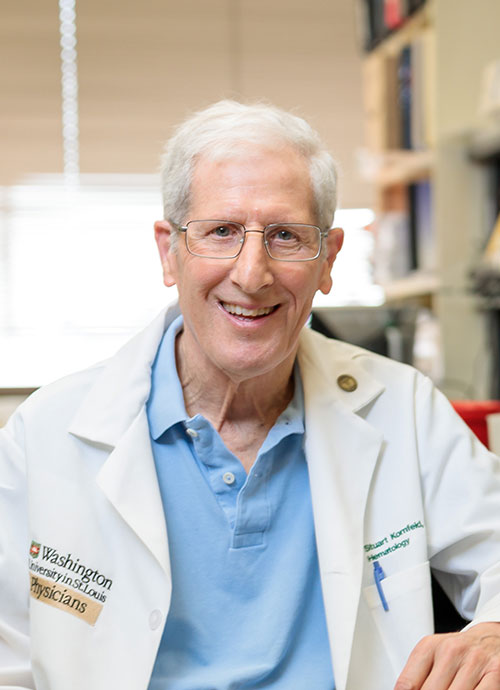
Kornfeld
Stuart A. Kornfeld, MD, the David C. and Betty Farrell Distinguished Professor Emeritus of Medicine at Washington University School of Medicine in St. Louis, died Sunday, Aug. 17, 2025, in St. Louis from complications of Parkinson’s disease. He was 88.
Kornfeld pioneered the study of glycoproteins — molecules present in living organisms and consisting of sugars attached to proteins — which play fundamental roles in the functions of cells, whether those cells are healthy or diseased. His body of work is a testament to the importance of basic biomedical research. Discoveries from his lab fueled clinical innovations across many areas of medicine, including the development of novel treatments for inherited genetic disorders called lysosomal storage diseases.
“Dr. Kornfeld was a prolific and pioneering scientist whose fundamental basic research in glycobiology has had outsized influence on multiple fields of science and medicine, including metabolism, cell biology, biochemistry, genetics, microbiology, immunology, hematology and oncology,” said Victoria J. Fraser, MD, the Adolphus Busch Professor and head of the Department of Medicine. “He was an incredible teacher and mentor, fostering research training, mentorship and scientific success for generations of trainees, many of whom are now leaders at institutions across the country and the world. He was also an enthusiastic booster of St. Louis and WashU Medicine, extolling their virtues to everyone he met. Dr. Kornfeld was universally admired by all who knew him, and his loss will be felt for generations to come.”
Over half a century of research, Kornfeld’s lab produced many key studies that have become classics in the field. His work continues to make up standard sections of biochemistry textbooks. One seminal article — co-authored by his wife, collaborator and fellow WashU Medicine glycobiology pioneer, the late Rosalind Hauk Kornfeld, PhD — has been cited more than 4,500 times and counting. The husband-and-wife team co-led the glycoprotein field for decades, co-authoring many foundational papers. Rosalind Kornfeld died in 2007.
Kornfeld’s research shed light on cell-waste disposal, protein transport, cellular movement, protein folding and immunity, among many other fundamental cellular processes. His foundational work led to better understandings of inherited genetic disorders called lysosomal storage diseases and set the stage for the development of new therapies. In 2018, he co-founded M6P Therapeutics, a biotechnology company developing next-generation therapeutics for lysosomal storage diseases including Tay-Sachs, mucopolysaccharidosis, Gaucher and Pompe diseases.
In addition to his foundational role in a field that has become central to translational medicine and drug discovery, Kornfeld was dedicated to mentorship and training of generations of physician-scientists. He directed the Medical Scientist Training Program from 1991-1997 and, seeing a gap in professional development for physician-scientists between graduation from MD-PhD programs and a first faculty appointment, Kornfeld founded the Physician Scientist Training Program in the Department of Medicine in 2000 and co-directed this innovative approach to professional development from 2000-2019.
The program was the first of its kind in the country to ensure that such clinician-researchers are well trained in both biomedical research and clinical medicine and have a clear career pathway. It has been so successful that similar programs have been adopted at more than 30 medical schools across the country, securing Kornfeld’s legacy as the “father” of physician-scientist training programs nationwide.
Kornfeld also held key leadership positions at WashU Medicine, including serving as co-director of the Division of Hematology-Oncology from 1976-1992 and co-director of the Division of Hematology from 1993-2009.
Kornfeld received many prestigious awards honoring his outstanding contributions to science, including the Passano Award, the Kober Medal, the E. Donnall Thomas Prize and the E.B. Wilson Medal. He was an elected member of the National Academy of Medicine, the National Academy of Sciences, the American Society for Clinical Investigation and the American Academy of Arts and Sciences.
Born in St. Louis in 1936, Kornfeld earned his bachelor’s degree from Dartmouth College in 1958 and his medical degree from WashU Medicine in 1962. He completed his residency training in internal medicine at what was then Barnes Hospital and continued his training in research at the National Institutes of Health. He returned to St. Louis in 1966 to join the WashU Medicine faculty.
A lifelong fan of the St. Louis Cardinals baseball team, Kornfeld was also a generous supporter of many of St. Louis’ defining cultural institutions, including the St. Louis Art Museum, the Missouri Botanical Garden, the St. Louis Symphony Orchestra and many more.
He is survived by his older daughter Katherine Kornfeld, senior director of foundation relations at WashU; his son Kerry Kornfeld, MD, PhD, a professor of developmental biology at WashU Medicine; his daughter-in-law Andrea Wilson; six grandchildren and two great-grandchildren; and his beloved friend of many years, Elizabeth Loeb. In addition to his wife, Rosalind Hauk Kornfeld, he was preceded in death by his younger daughter, Carolyn Kornfeld Lesorogol, PhD, who was a professor at the Brown School at WashU.
Information about an event celebrating his life will be shared in the future. Memorial contributions may be made to the Dr. Stuart Kornfeld Fellowship in the Division of Hematology, Department of Medicine at WashU Medicine.