
One patient’s story inspired emergency room physician to develop Hospital to Housing program
In caring for unhoused patients, Randall Jotte, MD, brings more than medicine
 Matt Miller
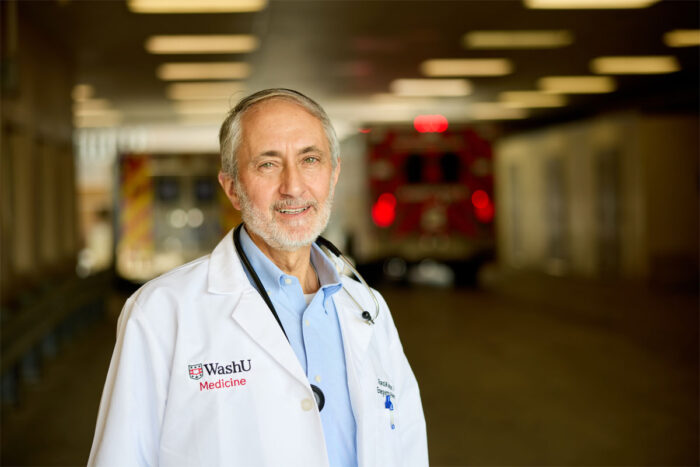
Randall Jotte, MD, a professor of emergency medicine at WashU Medicine, is a driving force behind the Hospital to Housing program. The innovative partnership with St. Patrick’s Center and other agencies aims to improve medical outcomes and reduce health-care costs by providing housing support for high-frequency users of the emergency room.
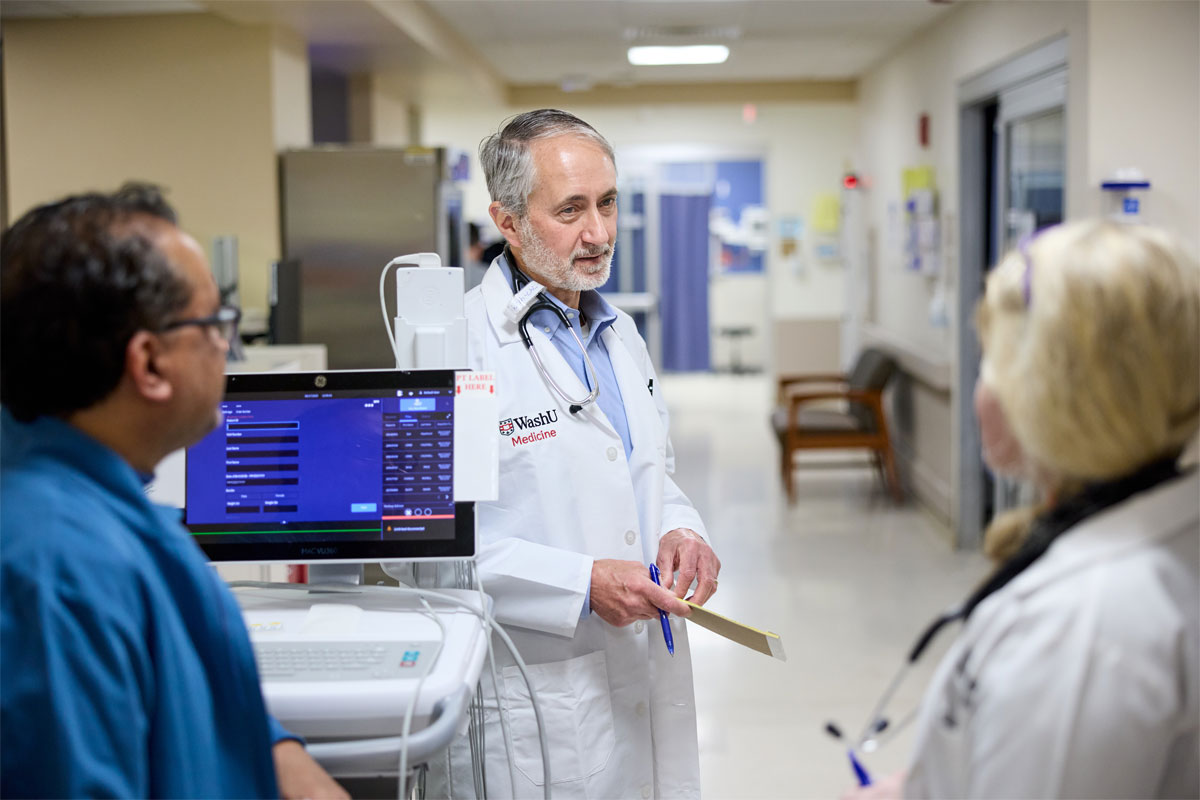
Each day, some 200 to 300 patients arrive at the Barnes-Jewish Hospital emergency department seeking care — many in pain, all in search of answers, healing and hope. Amid the constant motion and intensity, WashU Medicine physician Randall Jotte, MD, brings something else: a quiet steadiness and a lift in spirits. On a recent rainy Thursday, security staff at the entrance came in to chat with him, and triage nurses waved and smiled as he made his way through the exam areas, with a pause to check on how a patient-services concierge, new to the department, was enjoying her second shift of work.
Jotte’s warmth and equanimity have been assets over his 24 years — filled with unpredictable days — in the Barnes-Jewish emergency department. Still, he acknowledges that there are moments that throw him off balance, including one in October 2012 that changed the trajectory of his work in emergency care.
He had been asked by the then-chief of emergency medicine to develop a practical care-management plan for a middle-aged and unhoused man with chronic blood clots in his lungs. Records gathered by the chief resident at the time showed that the patient had been admitted to Barnes-Jewish and several other local hospitals 76 times over the previous two and a half years; no one knew why. To begin to puzzle it out, Jotte created a color-coded calendar that tracked the days of inpatient stays at different hospitals over a three-month period. He was incredulous at the result.
“It looked like a baseball team’s schedule, where there’s different colors for home and away games — he was three days here, three days there, five days here, seven days there,” Jotte said. “We realized that this patient was living at hospitals.”
Very little about the patient’s health conditions or his care plan had changed despite hundreds of hospital stays over the previous decade, during which he had amassed a collection of diagnostic tests and CT scans, all with largely the same results. Visits like these can place a burden on the health-care system, in part because balancing resources for patients whose care could be better resolved in non-emergency settings can mean that other patients might have to wait longer for care. For Jotte, this case was an opportunity that pointed to a new way of thinking about the care unhoused patients need.
“That patient was the one who made me start digging into this problem,” said Jotte. “In emergency care, you typically see patients for a short amount of time so it’s hard to really know what’s going on with patients in their everyday lives. We rarely have the opportunity to change how we think about delivering their care — but this was an opportunity for a change.”
New approaches for ‘familiar faces’
For Jotte, this experience was the genesis of Hospital to Housing, an innovative program launched in May 2019 that aims to improve medical outcomes and reduce costs by providing housing support to stabilize the lives of some frequent users of the emergency room. The program, primarily funded by The Foundation for Barnes-Jewish Hospital, has transformed the lives of vulnerable patients and reduced medical costs. Data from the pilot phase of the project showed that emergency room visits by participants were reduced by 53% and inpatient stays were reduced by 42%. The estimated savings for Barnes-Jewish was $12,500 per participant. Over 70 people have gone through the program since its inception.
 Matt Miller
The program could not have happened without looking into the larger context of the patient’s story.
Kelly Hanselman, the director of emergency services at Barnes-Jewish, said that “familiar faces” — patients who visit the emergency room far more than typical patients — sometimes show up a few times a month; others might visit a few times a day. Some may have home lives where they are subject to violence or abuse. Others are living with mental illnesses or substance use disorders, which can lead to or exacerbate chronic health problems.
For these latter patients, Jotte is often the go-to physician to treat them. And he consciously works to incorporate his expertise with this population into his training of WashU Medicine students and residents.
“He has a smile that makes patients feel like they can tell him anything, and he is really willing to listen, no matter how long the story is,” said Arrianna Thompson, MD, a former clinical fellow in the Department of Emergency Medicine, now practicing in Milwaukee. She volunteered with Street Medicine St. Louis to provide medical outreach for unhoused people in the city and frequently worked with Jotte in the emergency department.
“He focuses on what the person is there for and what they feel they need, which is not necessarily always what we as their doctors think they need, but both of those things are important,” she said.
Thompson credits Jotte with creating a general appreciation in the department and in the emergency room for the specific needs of this patient population. Most visit the emergency room with a legitimate medical need: medications that have been lost or stolen, rashes or infections caused by constant exposure to the elements, heat exhaustion in the summer and hypothermia in the winter. Often the underlying reason may be the need for a safe place to rest and have a meal.
Jotte and his colleagues in the emergency room — physicians, residents, nurses and social workers — collaborate to keep track of the familiar faces. Patients with complex mental health or substance abuse issues who appear ready and able to engage with the Hospital to Housing program are identified by an assessment team.
Jotte emphasizes the need to respect their dignity: Many don’t want to accept charity and will only participate when it is framed as a way to help their medical team manage their care. If they do accept, the social workers who work with Jotte pass on the patients’ names to Emily Brandt, the program coordinator and liaison at St. Patrick Center, the Catholic Charities of St. Louis ministry for the homeless. The St. Patrick Center is a central node in a coalition of hospital systems, housing providers, behavioral health and substance use service providers, and government agencies that are engaged in the Hospital to Housing initiative and its related programs.
The Hospital to Housing program currently supports five furnished apartments in St. Louis that participants, with the support of Brandt’s team, can use to help stabilize their lives as they transition to more permanent housing. The apartments are subsidized by the program while the initial setup, which includes a comprehensive move-in kit of hygiene products, clothing and bedding, is provided free of charge to participants through funding to the St. Patrick Center. The goal of the program is to help participants with substance abuse issues get into rehabilitation, organize appropriate documentation to receive government-aid, including sometimes Social Security Numbers and identification, and assist them in finding permanent subsidized housing within three to six months of entry into the program. Jotte remains involved in this phase as well, helping the participants’ case managers connect with the appropriate WashU clinicians in Barnes-Jewish Hospital clinics.
One participant who started in the program this year moved into a Housing to Hospital-supported apartment in March. A St. Louis native, she had been living in tents and shelters for about 10 years. She has struggled with substance abuse but takes pride in her ability to look after herself. Nonetheless, the past winter was hard — the cold and snow made her pre-existing medical conditions flare up. It made her particularly vulnerable to theft on the streets, she said.
“When you go to sleep, or pass out because you are sick, people will go through your pockets and take your money and even your medication,” she said. Her frequent visits to the emergency room to replace her medications put her on the radar for the Hospital to Housing program. She was ready to change her life, and, with the help of the St. Patrick Center staff, has been able to manage her health and medical needs. She has not been back to the emergency room since moving into her apartment. The program feels like a new chapter in her life, she said.
“I’m looking forward to seeing something different in life, avenues that look better, streets that look better,” she said. “My thing is I want to see brighter lights, right?”
Always pushing to find solutions
Not everyone who participates in the program finds long-term stability, but that participant’s trajectory is the goal, said Jotte. There’s a sensible financial argument for the program: the more that relatively minor medical needs are addressed by family physicians, pharmacies or walk-in clinics, the more resources are freed up for the emergency room to focus on critical needs. The program has saved hundreds of thousands of dollars for Barnes-Jewish Hospital by reducing emergency room and inpatient costs, which does not even account for the likely savings accrued by other regional health systems that see the same patients, or from the reduced Medicare and Medicaid claims. Patients do better as well, because having an address where they can be reached for medical follow-ups and safely store their medication is fundamental to successful care. Jotte, with the backing of WashU Medicine and WashU’s Institute of Public Health, is working with the Missouri Hospital Association, an umbrella industry group for 137 of the state’s health-care institutions, and many other governmental, private sector and nonprofit stakeholders to find ways to expand the program in St. Louis and to other locations in the state and possibly find permanent funding for it.
When Jotte talks about Hospital to Housing, he emphasizes the benefits to patients and the cost savings and efficiency benefits for the health-care system, but the program also has made him a better doctor. Over time, Jotte has come to find treating the patients served by Hospital to Housing has led him to appreciate that a patient’s real needs may lie beyond their initial symptoms or injuries.
“Caring for unhoused patients is a different kind of challenge, and at WashU Medicine, we push ourselves to find solutions. You do what you can, and I think we are called to go beyond our comfort zone.”
That call to go beyond, he said, is partially inspired by another Hospital to Housing participant. He told Jotte how he had encountered a man digging through the trash for food. Determined to help, despite the man’s own precarious circumstances, he spent $20 of his own money to buy the hungry stranger a pizza.
“That’s a lot of money for someone like him,” said Jotte. “This guy gave half of everything he had — maybe most of what he had — certainly more than what I would have given. These are among the most marginalized people in society, so it’s the kind of thing that makes you think, what am I doing with my time? Can I do more?”