

Stimulant ADHD medications work differently than thought
Brain areas affected by the drugs control reward and wakefulness, not attention, study shows
 Benjamin Kay
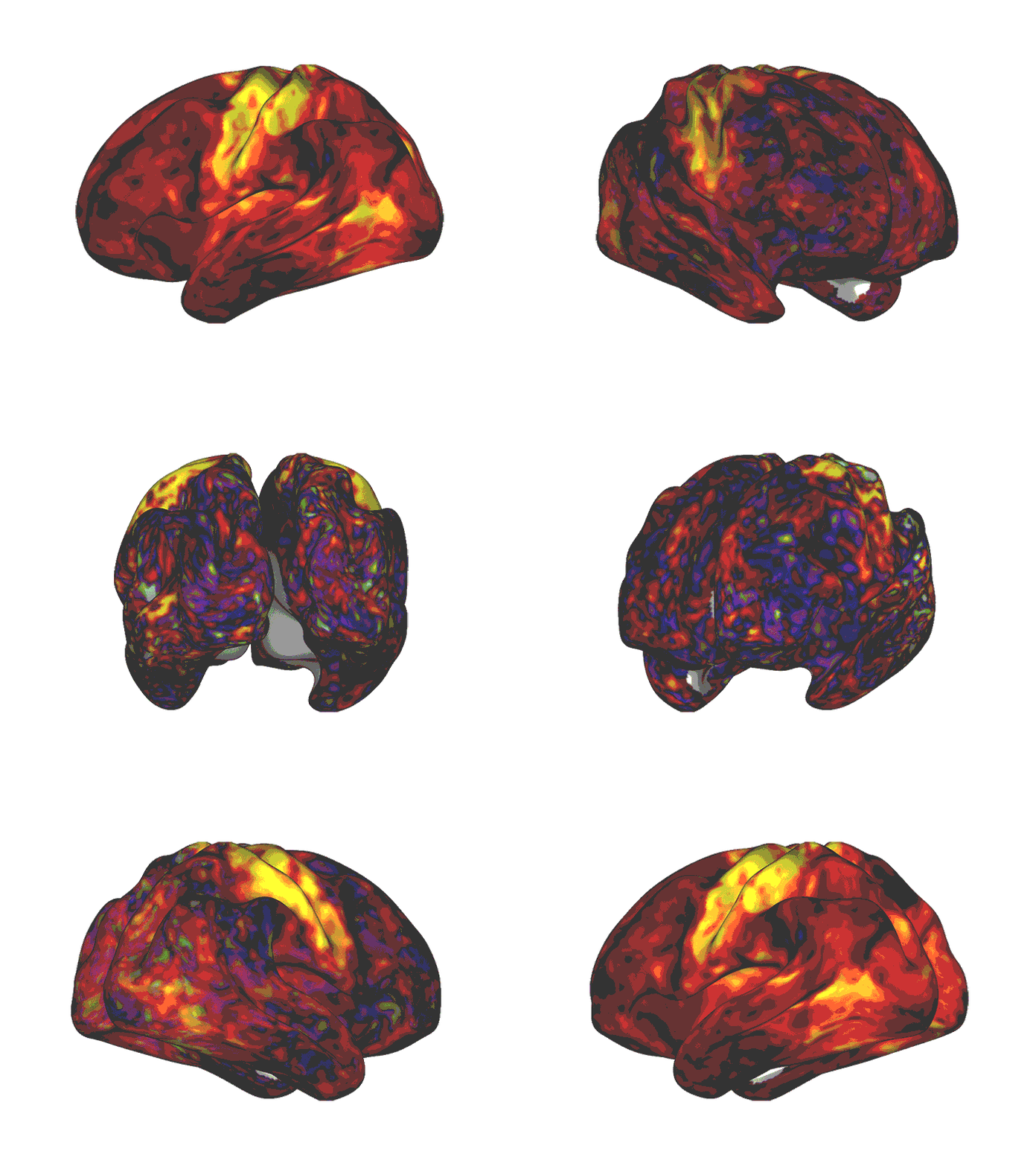
WashU Medicine researchers find stimulant medications don’t affect attention-controlling regions of the brain, as previously thought. Brain scans show the drugs affect brain areas involved in wakefulness and reward, highlighted in yellow and orange above.
Prescription stimulants, such as Ritalin and Adderall, are widely used to treat attention deficit hyperactivity disorder (ADHD), including in children. In the U.S., about 3.5 million kids ages 3 to 17 take an ADHD medication, a number that has increased as more children have been diagnosed with the neurodevelopmental disorder.
Stimulant medications have long been thought to treat ADHD by acting upon regions of the brain that control attention, but a new study by researchers at Washington University School of Medicine in St. Louis casts doubt on that thinking. Led by Benjamin Kay, MD, PhD, an assistant professor of neurology, and Nico U. Dosenbach, MD, PhD, the David M. & Tracy S. Holtzman Professor of Neurology, it shows for the first time that these drugs act primarily on the brain’s reward and wakefulness centers, rather than on its attention circuitry.
The findings, published Dec. 24 in Cell, suggest that prescription stimulants enhance performance by making individuals with ADHD more alert and interested in tasks, rather than directly improving their ability to focus. The researchers also found that stimulant medications produced patterns of brain activity that mimicked the effect of good sleep, negating the effects of sleep deprivation on brain activity.
“I prescribe a lot of stimulants as a child neurologist, and I’ve always been taught that they facilitate attention systems to give people more voluntary control over what they pay attention to,” said Kay, who treats patients at St. Louis Children’s Hospital. “But we’ve shown that’s not the case. Rather, the improvement we observe in attention is a secondary effect of a child being more alert and finding a task more rewarding, which naturally helps them pay more attention to it.”
Kay said the findings point to the importance of addressing inadequate sleep in addition to considering stimulant medication for children being evaluated for ADHD.
Unexpected brain activity
To understand how stimulant medications affect the brain, the research team examined resting-state functional MRI, or fMRI, data — a type of neuroimaging that indicates a person’s brain activity when they are not engaged in any specific task — from 5,795 children ages 8 to 11 who participated in the Adolescent Brain Cognitive Development (ABCD) Study. The ABCD study is a long-term, multisite study that is tracking the neurodevelopment of more than 11,000 children from across the U.S., including a site based at WashU Medicine.
The researchers analyzed fMRI scans and compared brain connectivity patterns between children who took prescription stimulants and children who did not on the day of their scan. Compared with kids not taking stimulants, children who took stimulants the day of the scan showed increased activity in regions of the brain related to arousal or wakefulness and regions predicting how rewarding an activity will be. Their scans did not show significantly increased activity in regions classically associated with attention.
The researchers validated their observation in an experiment on five healthy adults without ADHD who normally did not take stimulant medication. The participants were scanned using resting-state fMRI before and after taking a dose of stimulant medication, allowing for precise measurement of changes in brain connectivity. The researchers again found that arousal and reward centers in the brain, not attention centers, were activated by the medications.
“Essentially, we found that stimulants pre-reward our brains and allow us to keep working at things that wouldn’t normally hold our interest — like our least favorite class in school, for example,” Dosenbach said. In other words, the study findings suggest that rather than “lighting up” the attention centers of a child with ADHD, stimulant drugs work by helping make activities that the child normally struggles to focus on feel relatively more rewarding, he noted. That extra motivation helps kids continue challenging activities as well as tedious tasks.
“These results also provide a potential explanation for how stimulants treat hyperactivity, which previously seemed paradoxical,” Dosenbach added. “Whatever kids can’t focus on — those tasks that make them fidgety — are tasks that they find unrewarding. On a stimulant, they can sit still better because they’re not getting up to find something better to do.”
Stimulants, ADHD and sleep
Compared with children with ADHD who did not take a stimulant, children with ADHD who took a stimulant medication had better grades in school (as reported by their parents) and performed better on cognitive tests given as part of the ABCD study. Children with more severe ADHD showed the greatest gains in cognitive outcomes associated with taking prescription stimulants.
Despite their significant effects on brain activity, the researchers found that stimulant medications were not associated with cognitive gains in all children taking them. Children who got less than the recommended nine or more hours of sleep per night and took a stimulant received better grades in school than did kids who got insufficient sleep and did not take a stimulant. However, stimulants did not correspond with improved performance for neurotypical kids who got sufficient sleep. (It is not clear why these kids were taking stimulant medications.) That is, stimulants were linked with improved cognitive performance only for participants with ADHD or those who got insufficient sleep.
“We saw that if a participant didn’t sleep enough, but they took a stimulant, the brain signature of insufficient sleep was erased, as were the associated behavioral and cognitive decrements,” Dosenbach said.
The authors noted that this boost in performance despite a lack of sleep might carry long-term costs.
 Matt Miller/WashU Medicine
“Not getting enough sleep is always bad for you, and it’s especially bad for kids,” Kay said. He noted that children who are overtired may exhibit classic symptoms of ADHD, such as difficulty paying attention in class or declining grades, leading to a misdiagnosis in some cases when the real culprit is sleep deprivation. The stimulant medication may then appear to help by mimicking some of the effects of a good night’s sleep, while still leaving the child vulnerable to long-term effects of sleep deprivation. Kay urged clinicians to consider sleep deprivation as a factor in ADHD diagnoses and to explore strategies or treatments to boost kids’ sleep.
Dosenbach and Kay’s results point to the need for future studies on the potential long-term effects of stimulants on brain function. The researchers noted that these medications could have a restorative effect by activating the brain’s waste clearing system during wakefulness, but it’s equally likely they might cause lasting damage if used to cover up chronic sleep deficits.