
Together, WashU Medicine MD, OT, PT students treat patients at Pro Bono Health Clinic
Student-led clinic delivers much-needed care to uninsured people in the St. Louis area
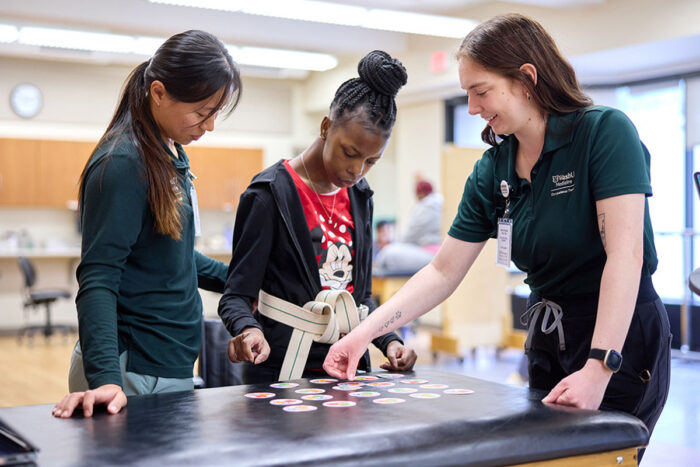 Matt Miller / WashU Medicine
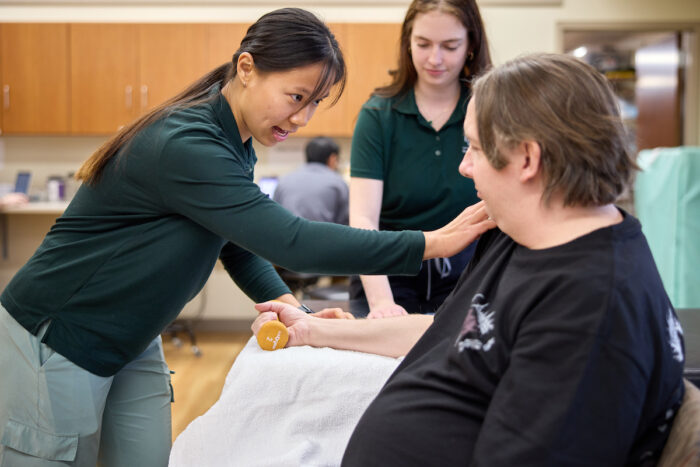
Lapada Pavanacharoensuk (left), a WashU Medicine physical therapy student volunteer, and Mackenzie Halton (right), a WashU Medicine occupational therapy student leader, work together with a patient on balance, motor skills and memory at the Pro Bono Health Clinic. Medical, occupational therapy and physical therapy students provide services to uninsured and underinsured community members every Friday afternoon.
Makenna Dixon remembers all the appointments during her childhood.
Her mother suffered from autoimmune diseases that required countless trips to physical therapy. As her health conditions worsened, Dixon’s mom could no longer work a full-time job, and the lack of insurance through an employer made therapy one financial challenge among many.
For Dixon, now a third-year student in the WashU Medicine Program in Physical Therapy, watching her mother’s health decline fueled her fervor to advocate for people who don’t have health insurance. Those early experiences also influenced her decision to pursue a degree in physical therapy, and the Pro Bono Health Clinic drew her to study at WashU Medicine.
The WashU Medicine Pro Bono Health Clinic offers free occupational therapy (OT), physical therapy (PT) and medical intermediary services to uninsured community members in the St. Louis area. Medical intermediary care covers conditions such as diabetes, hypertension and other acute concerns for patients who are waiting to become established with a primary care provider.
The student-led effort, under direct clinical faculty supervision, provides informed, compassionate care to patients and trains learners through hands-on opportunities that introduce them to clinical and nonclinical factors that impact health.
Dixon said one day she hopes to manage a pro bono clinic of her own.
“Too often the community members we see struggle with basics like lack of food or transportation or a roof over their heads — things that can significantly impact their everyday lives and overall health,” Dixon said. “That’s why the Pro Bono Health Clinic prioritizes listening and addressing the whole patient.”
Patient-first, student-run
Each week, Dixon and a rotating team of other students see patients like Isheka Reynolds.
Reynolds, a St. Louis resident and mother of three, likens her ailments to a game of pingpong. The shots of pain start in her back, travel down her left hip and then send burning, tingling sensations to her knees and numbing toes.
“It’s like my body is trying to push and pull me all at the same time,” Reynolds said. Her herniated discs and neuropathy not only make it hard for Reynolds to get out of bed some days, but they also make it next to impossible to maintain a job.
The Pro Bono Health Clinic was designed with people like Reynolds in mind.
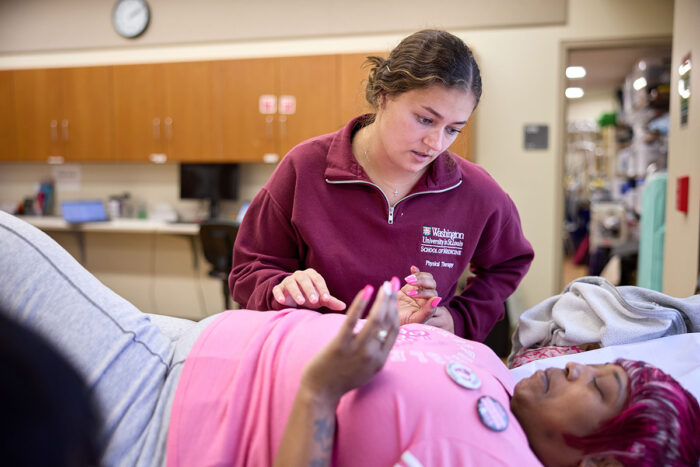 Matt Miller / WashU Medicine
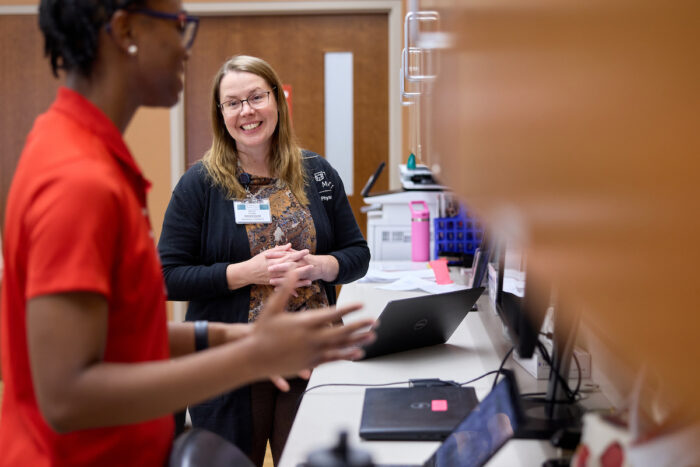
She visits the clinic for physical therapy every other week, free of charge. By helping Reynolds with movement correction exercises and modifications to everyday positions and activities, students strive to alleviate her pain, bring a smile to her face and also check on any nonclinical needs she may have. Meanwhile, Stacy Tylka, physical therapy lead and a professor of physical therapy, oversees the treatment, willing to provide feedback as necessary.
 Matt Miller / WashU Medicine
Tylka says the clinic was designed so that students serve as the primary caregivers while clinical professors take a more supervisory role. The environment offers learners the opportunity to refine their patient interviewing skills, practice building rapport, learn flexibility in real time and master the art of letting patients lead the discussion.
“Collectively, these experiences enable students to be adaptable and always put the patients’ needs first,” Tylka said.
Although Reynolds currently lives with her daughter, she hopes the pain will subside enough that she can work again and someday have a place of her own.
“I feel honored and thankful to be a patient at the Pro Bono Health Clinic,” she said. “I am very grateful to be in the care of such an amazing team.”
Collaboration across disciplines
Planning and design began long before the Pro Bono Health Clinic officially opened in February 2022. Tylka joined WashU Medicine colleagues Barbara Lutey, MD, the clinic’s medicine lead and an associate professor of medicine, and Jessica Dashner, occupational therapy lead and an associate professor of occupational therapy, to envision what this OT/PT/medical intermediary one-stop shop could become.
With no playbook to consult, the planning team worked together during the height of the COVID-19 pandemic to design a patient-centric model that was inclusive of all three disciplines, run by students and available to uninsured and underinsured St. Louisans each week.
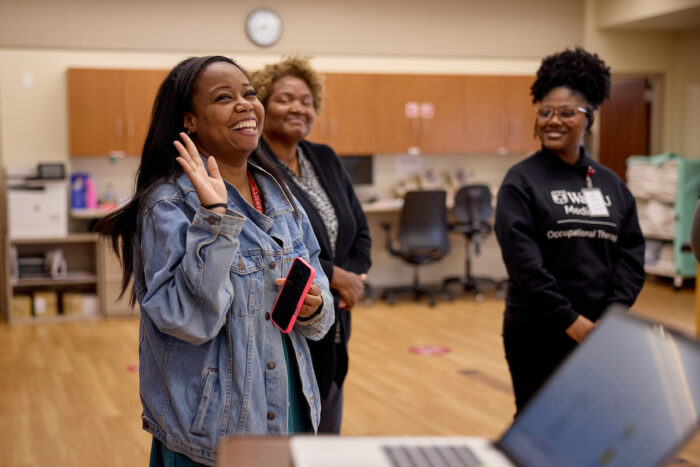
“This type of endeavor would never happen without such a collaborative team,” Dashner said. “Each of us knew what our particular discipline could do to serve St. Louis community members, but it was truly transformative to merge these ideas into an end product that represented all of our perspectives and seamlessly addressed our patients’ and learners’ unique needs.”
The Pro Bono Health Clinic intentionally makes all three disciplines available from one centralized location. Sophia Dietz, a second-year medical student and student leader at the clinic, appreciates that individuals can have three caregivers sit and listen to their story all at the same time, so patients do not have to navigate multiple facilities and appointments.
“It’s been inspiring to be a part of a community of individuals who are all specialists in their area, who then work together with the patient to come up with the best solutions to improve their condition.”
 Matt Miller / WashU Medicine
Bridging the gap
Studies show that up to 80% of a person’s health – including their physical environment, social and economic outlook, and health behaviors — may weigh more heavily on wellness than clinical care alone. That’s why the Pro Bono Health Clinic doesn’t stop at offering OT, PT and medical intermediary services. It also offers a bridge to other points of care, services and resources.
 Matt Miller / WashU Medicine
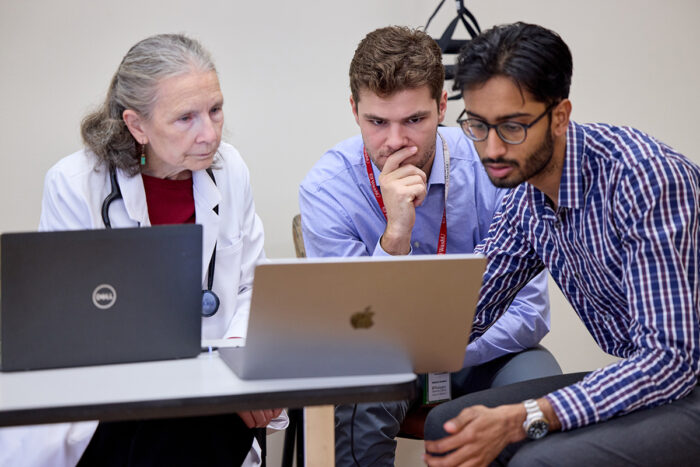
Depending on a patient’s needs, the medical intermediary team determines next steps for each individual. When needs surpass the scope of what the clinic can provide, it relies on a partnership with the St. Louis Integrated Health Network (IHN), which represents a majority of the region’s health care safety net. The IHN is a health care intermediary composed of four federally qualified health centers, two major hospital systems, two medical schools — including WashU Medicine — and two public health departments. Through its programs and initiatives, IHN and its partners collaborate to meet the health-care needs of the St. Louis region.
Cheryl Clerkly, an IHN community referral coordinator, works alongside the medical intermediary team most Fridays. Together they assess patients’ immediate needs and discuss relevant resources. Clerkly then assists patients with higher-level needs such as applying for public assistance, arranging reliable transportation for medical appointments or applying for housing.
Impacting lives and learners alike
A few months ago, Dixon had a memorable encounter at the Pro Bono Health Clinic, and she knew who she wanted to tell first.
“My patient had experienced a lot of mental health issues on top of mobility challenges,” Dixon said. “At the end of the session, she said it was one of the first times in her life that someone really listened to her and was willing to help.”
Dixon went straight home and called her mom.
“Even now it makes me want to cry tears of joy, thinking about how I not only helped the patient gain movement, but I was there for her in a way no one else was,” Dixon said. “Together we found resources that will change her life for the better.”
 Matt Miller / WashU Medicine
Visit the Pro Bono Health Clinic website to learn more.