
Wang named Robert C. Packman Professor
Renowned virologist developed tools to discover and study novel viruses to advance public health
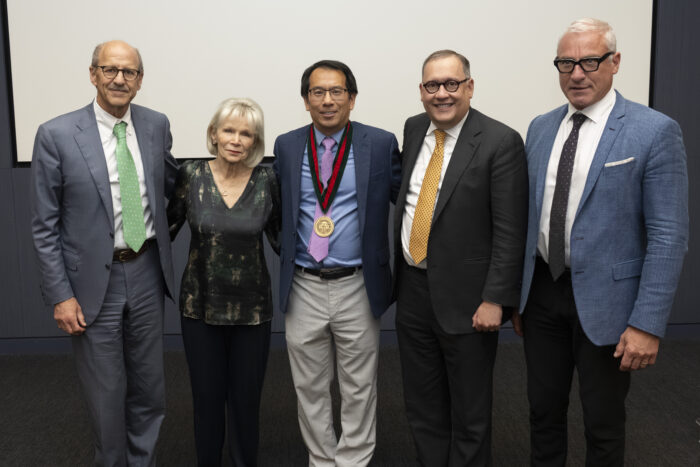
David Wang, PhD, has been named the Robert C. Packman Professor at WashU Medicine. Pictured at his installation ceremony are (from left) David H. Perlmutter, MD, dean of WashU Medicine; Noémi Neidorff; Wang, Chancellor Andrew D. Martin and Sean Whelan, PhD, head of the Department of Molecular Microbiology.
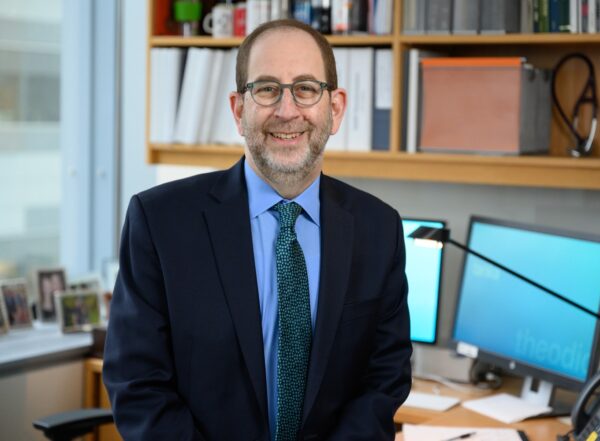
David Wang, PhD, an acclaimed microbiologist and virologist known for his work identifying new viruses and understanding their roles in human diseases, has been named the Robert C. Packman Professor at WashU Medicine.
Generous contributors to WashU, Noémi Neidorff and her late husband, Michael, established the professorship at WashU Medicine to honor Robert C. Packman, MD, a former WashU Medicine faculty member and senior vice president of medical affairs at St. Louis-based Centene Corp., where Michael Neidorff was chairman, president and chief executive officer. Wang was installed by Chancellor Andrew D. Martin and David H. Perlmutter, MD, executive vice chancellor for medical affairs, the Spencer T. and Ann W. Olin Distinguished Professor and the George and Carol Bauer Dean of WashU Medicine.
“The Neidorffs have long supported biomedical research at WashU, and I applaud their recognition that virology research — and talented virologists like David Wang — will be critical to helping our world confront everyday viral diseases as well as future pandemics,” said Chancellor Andrew D. Martin. “Robert Packman’s compassion and commitment to improving health care have inspired generations of WashU Medicine physicians. This professorship stands as a testament to his lasting impact.”
Wang developed state-of-the-art tools for sequencing and identifying viruses, which he has applied to find viruses associated with respiratory and intestinal disease and other common illnesses. Wang has also taken a novel approach to using the nematode worm C. elegans as a model organism. His approach led to the discovery of Orsay virus, a virus that infects nematodes but not humans, and enabled Wang to use C. elegans genetics to understand what was required for infection by Orsay virus. This revealed remarkable parallels to how viruses like poliovirus infect human cells.
“David Wang is redefining how we discover and understand viruses — work that sits at the intersection of basic science and public health,” Perlmutter said. “By developing powerful tools to identify novel viruses and reveal how they interact with their hosts, he has transformed our ability to respond to infectious disease threats as they evolve. Michael Neidorff had the vision to realize that better understanding of viruses and how the host responds to them — accomplished through basic science — was how WashU Medicine could continue to have a positive impact here in St. Louis and around the world.”
Wang’s focus on how novel viruses interact with humans and other host organisms has proven particularly applicable to public health. One of his most significant achievements is the development of the Virochip, a DNA-based viral detection tool that can identify well-known as well as novel viruses. This innovative technology became crucial in 2003, when it helped identify the virus responsible for the first SARS outbreak, showcasing its ability to address urgent public health crises. In addition, Wang studies the human virome, which is the community of viruses present in and on human bodies, and how this community changes with age and during illnesses.
Wang’s research also explores astroviruses, a family of viruses often associated with gastrointestinal illness. His work has revealed that these viruses, previously thought to infect only the digestive system, can also infect other tissues, including the brain. This unexpected finding has implications for understanding viral diseases and their potential impacts on neurological health.
Wang previously led one of 10 NIH-funded Centers for Research in Emerging Infectious Diseases, a coordinated network with collaborators in different regions across the globe where emerging and re-emerging infectious disease outbreaks have proven likely to occur.
“Discovery and collaboration epitomize David Wang’s work and his approach to virology,” said Sean Whelan, PhD, the Marvin A. Brennecke Distinguished Professor and head of the WashU Medicine Department of Molecular Microbiology. “Dr. Wang’s expertise in viral discovery, which is an area foundational to the very discipline of virology, has led to transformative advances in the field through the development of model systems and tools to study viral pathogens. His impact extends well beyond the lab through his leadership of an NIH-funded center for research, as well as his teaching and mentorship.”
A native of Los Angeles, Wang completed his undergraduate degree in chemistry at Stanford University in 1992 and earned his doctoral degree in biological chemistry from MIT in 1998. Wang joined WashU Medicine in 2004 with a joint appointment in molecular microbiology and pathology and immunology. In 2008, he won a Burroughs Wellcome Fund Investigators in the Pathogenesis of Infectious Disease Award, and he is a fellow of the American Academy of Microbiology.
About Michael and Noémi Neidorff
Michael Neidorff was chairman, president and chief executive officer of Centene, a multinational health-care enterprise with more than 14 million members. He served on the boards of many regional and national arts, medical and educational organizations, and was a former member of the National Council of the Brown School at Washington University. Michael Neidorff died in April 2022.
In 2019, during Michael Neidorff’s tenure as Centene’s chairman, the company and WashU announced a partnership to advance research aimed at developing personalized approaches to preventing and treating Alzheimer’s disease, breast cancer, diabetes and obesity — conditions that affect millions worldwide. As part of the partnership, Centene provided $50 million for WashU Medicine’s Personalized Medicine Initiative, which supports research that tailors disease prevention and treatment based on patients’ genetic, environmental and lifestyle factors.
Noémi Neidorff is a classically trained musician and an active leader in the arts community. A native of Budapest, Hungary, Noémi Neidorff fled the country with her parents during the 1956 Hungarian Revolution. She went on to become a classical pianist after earning bachelor’s and master’s degrees from the Manhattan School of Music. She continued postgraduate studies at Columbia University. She and Michael served as co-chairs on the Kennedy Center’s International Committee on the Arts, and she was a past president of the National Symphony Orchestra’s National Trustees. Noémi Neidorff serves as a vice chairman on the board of the St. Louis Symphony Orchestra, on the board of the Budapest Festival Orchestra and on the executive committee of the Manhattan School of Music. She is the immediate past chairman of the board of Opera Theatre of Saint Louis. She also played a significant role in founding the radio station Classic 107.3 FM, a station focused heavily on classical music and the arts.
The Neidorffs have long been impressed with the quality of care delivered by physicians at WashU Medicine. When they established the Robert C. Packman Professorship in virology, they also endowed the John S. Daniels Professorship in immunology. They previously have provided financial support to WashU Medicine for research into surgical treatments for pancreatic and gastrointestinal diseases, and to the university’s Brown School for health disparities research. The Neidorffs, along with Centene, also endowed the Neidorff Family and Centene Corporation Dean of the Brown School.
About Robert C. Packman
After Packman earned his bachelor’s and medical degrees from WashU, he completed specialty training in endocrinology at Duke University. He served as professor of clinical medicine at WashU Medicine for more than 35 years, specializing in endocrinology, diabetes and metabolism. After retiring from clinical practice, he joined Centene Corp., a young regional insurance company at the time, as chief medical officer. As the company grew, he was appointed senior vice president of medical affairs and continued in an advisory role until his retirement.
Packman was a dedicated and accomplished physician, devoted to the care of his patients and committed to improving the delivery of health care for all. As a former chief resident at Barnes Hospital, he designed and created the first modern edition of the Washington Manual of Medical Therapeutics, transforming what had been a handbook for in-house medical trainees into a portable reference for clinicians everywhere that continues to be one of the best-selling medical textbooks worldwide. He was actively involved in the care of patients during the early days of the AIDS epidemic and was known for his compassion.
Two professorships have been established in Packman’s name at WashU Medicine: the Neidorff Family and Robert C. Packman Professorship and the Robert C. Packman Professorship in virology. Packman died in September 2023.