
WashU Medicine’s head student coach
Physician, educator Amjad Musleh mentors aspiring physicians in compassionate care
 Matt Miller
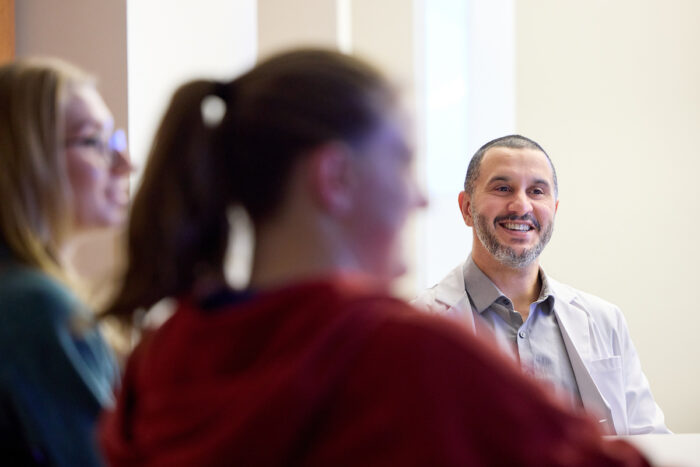
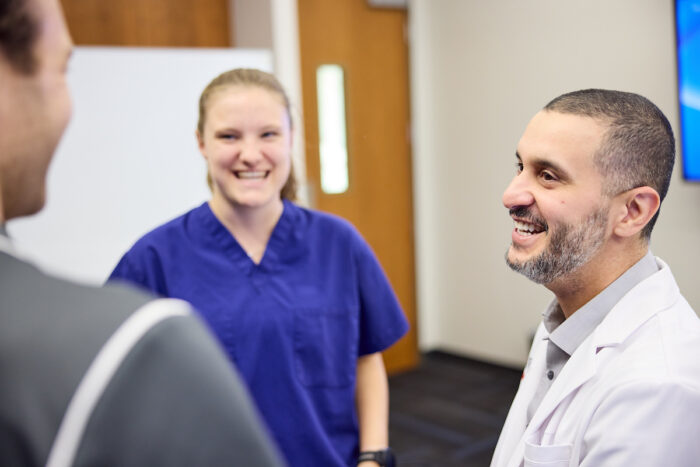
Amjad Musleh, MD (right), an associate professor of anesthesiology and of emergency medicine at WashU Medicine, is the school’s head coach tasked with helping students professionally and personally throughout their journey to becoming physicians or physician-scientists. He meets with students individually and in small groups to navigate challenges and celebrate successes.
In 1995, at age 9, Amjad Musleh, MD, earned $20 a day working with his uncle on weekends at a sporting goods store in Baton Rouge, La. He helped open and close the shop, lifted boxes and ran back and forth retrieving sneakers in different sizes. His job contributed to family expenses, and he had fun working, but when he received his share, the boy wanted to keep it.
His mother had other ideas. Nadia Khader, a daughter of Palestinian refugees, had grown up poor and was helped by her community. She chose to do the same as a mother in the U.S. After Amjad Musleh’s payday, she would take her son to a charity — whether it was one that cared for the unhoused, the hungry or English-as-a-second-language learners.
“Go walk over there, talk to that lady who’s in charge and give your money to her,” Musleh recalled his mom saying.
When her frowny boy objected, she told him, “Your money belongs to other people, too.”
“At the time, we were struggling, but we had food and a place to live,” Amjad Musleh said. “Before then, our community had helped us every step of the way. My mother wanted me to understand it was important to give to those who didn’t have as much as we did. As I matured, I realized the importance of empathy and of donating my time and resources. People need to take care of one another.”
At WashU Medicine, Musleh is an associate professor of anesthesiology and of emergency medicine, and co-director of a critical-care ultrasound fellowship training program. He has received honors for providing compassionate care to his patients at Barnes-Jewish Hospital, where he co-directs the Acute Care Team, and for his volunteer service, including an emergency medical mission in 2024 in the war-ravaged Gaza Strip at one of the few functioning hospitals.
Musleh is also a popular educator and mentor to students, residents, fellows and faculty colleagues. Earlier this year, he was appointed the medical school’s head coach, also known as the director of the Gateway Coaching Program, which supports medical students professionally and personally throughout their journey to becoming physicians or physician-scientists. The program enhances the traditional academic advising model with faculty coaches who meet with students longitudinally.
“Amjad is an outstanding academic coach,” said Eva Aagaard, MD, vice chancellor for medical education, vice dean for education and the Carol B. and Jerome T. Loeb Professor of Medical Education at WashU Medicine. “He is an empathetic clinician and a trusted educator who students, residents and fellows gravitate to when they’re discouraged or confused, or when they’re in need of comfort, conversation or a welcoming smile. He’s beside them during their ups and downs, guiding them to reach their highest potential, and now he guides all coaches to achieve the same impact.”
An enduring impact
For Arielle Soldatenko, a fourth-year medical student in Musleh’s coaching group, he is the first person she thinks of when she needs academic or clinical support, as well as the first person she wants to tell about her successes.
“Amjad is the epitome of humanism in medicine,” said Soldatenko, who is applying for residencies in emergency medicine. “He is the warmest, kindest, most humble soul I’ve ever met. As a mentor, he balances being our biggest supporter and also pushing us to be better. Listening to him speak to patients has already taught me so much about how to connect with them and be a comforting presence during a difficult moment.”
Musleh exemplifies WashU Medicine’s holistic approach to medical education, a hallmark of the revamped curriculum that launched in 2020 and reflects the school’s mission of patient care, research and education.
The American Association of Medical Colleges cites mentorship as a critical component of medical education because it enhances students’ well-being, prevents burnout and builds confidence. It also fosters resilience and creates a self-awareness that can shape their values and priorities as physicians and influence their professional development.
“Mentorship thrives at WashU Medicine,” Musleh said. “Doesn’t matter your role. People care about each other, more so than any place I’ve worked.”
 Matt Miller
In his coaching role, Musleh also oversees faculty training on impactful coaching that emphasizes trust and problem-solving with sessions such as navigating difficult conversations or understanding how socioeconomic backgrounds can affect patient perspectives.
For all mentees and coachees, Musleh channels his mother by encouraging them to consider their legacy.
“My mother would say to me, ‘We’re all going to die. What lasting impact will you leave?’”
A medical school family
Legacy is often discussed with students during one-on-one and small group coaching sessions. During the conversations, Musleh makes himself vulnerable to students, for example, by recalling his professional setbacks or his struggle with imposter syndrome, the self-doubt many high-achievers experience.
Just as important, Musleh shares the critical-thinking skills that helped him bounce back and persevere, for instance, by reframing a failure not as a defeat but as a lesson learned that propels success.
Musleh also offers a respectful, judgment-free space for students. He connects and reflects with them over communal experiences encountered in medical school, such as each student’s relationship with their first patient, a human cadaver. More broadly, they discuss topics relevant to the health-care field, perhaps ethics involving organ donation and transplantation, or dignified dying among the terminally ill.
“Amjad’s coaching group was my medical school family,” said Hana Hajda, MD, a 2024 WashU Medicine graduate pursuing an adult general psychiatry residency at Brown University Health hospitals in Providence, R.I. “Even now, when a lot of us have moved to different parts of the country for our respective residency programs, the people from this group are still the first ones I’ll call to debrief after big experiences in the hospital.”
Hajda credits the group’s familial bonds to Musleh. “He has a gift of supporting people, seeing the best in them,” she said. “He set the tone for the type of leadership and mentorship I hope to give to others one day.”
In April, WashU Medicine students recognized Musleh with the Humanism in Medicine Award, presented annually by the Association of American Medical Colleges. The honor celebrates faculty physicians who exemplify the qualities of a caring and compassionate mentor in the teaching and advising of medical students.
Musleh’s impact is one of his legacies, said Brian Dineen, a fourth-year medical student applying for residencies in internal medicine.
“Amjad’s mantra is that the most important thing in life is to make a positive effect that will last even after you’re gone,” Dineen said. “This is a high bar, but every day, he makes a difference to those around him. So many students, residents, faculty and patients are better off for the time they spent with him. His influence on my path is a small part of the goodness that he brought to the world.”
Amjad Musleh
Age: 39
Family: Married to Rehab (means welcomeness in Arabic) since 2013, and they have three children: Nadia (9), Malik (6), Layla (5). His parents, Nadia Khader and Issam Musleh live in Albuquerque, N.M. Musleh is the oldest of six brothers and one sister.
Education: He earned his medical degree at the University of New Mexico School of Medicine in 2013 and finished a residency in emergency medicine there in 2016. He followed it up with a fellowship in emergency medical services at the same institution. Musleh then attended WashU Medicine for a fellowship in critical care medicine, completed in 2019; shortly after, he was appointed to faculty here.
Additional appointments: Co-medical director of the Barnes-Jewish Hospital Acute Care Team and medical director of Jefferson College Paramedic Program in Arnold.
Favorite food: Fassoulyeh khadra, “a folky kind of food,” he said, composed of green beans, onions and tomato sauce over basmati rice.
Favorite St. Louis activity: “Playground hopping, which is basically trying out every playground in the region with my kids. My favorite, so far, is O’Day Park [in O’Fallon, Mo.] and Indian Camp Creek Playground [in Foristell, Mo.].
Favorite recent vacation: He and his wife took Musleh’s parents on the Hajj, a “once-in-a-lifetime trip to Mecca, Saudi Arabia for a six-day pilgrimage. Every year, millions of Muslims do it, and it was my mother’s life goal. She’s in a wheelchair, and it’s in the middle of the desert and very hot, but she did great. I packed a lot of portable fans and water, and it’s probably nice she had her own personal emergency room doctor. The trip is a happy memory for me.”