
Who wrote the book on medicine? We did!
WashU Medicine publishes 38th edition of acclaimed textbook
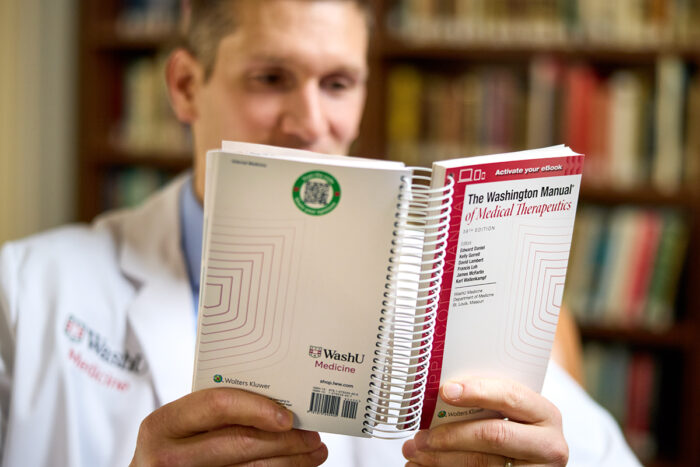 Matt Miller/WashU Medicine
Thomas Ciesielski, MD, an associate professor of medicine at WashU Medicine, admires the recently published 38th edition of “The Washington Manual of Medical Therapeutics,” a bestselling medical book used by doctors around the world. Ciesielski served as the executive editor.
Renowned for excellence in patient care, research and education, WashU Medicine is also a publishing powerhouse, home to the No. 1-selling medical textbook in the world.
The book — known formally as “The Washington Manual of Medical Therapeutics” and informally as “the bible of the medical ward” — has taught generations of physicians how to care for patients since it was first published in 1943.
A product of the John T. Milliken Department of Medicine, the manual is planned, written, edited and produced by chief residents in internal medicine in collaboration with veteran faculty and staff. The team ensures each chapter contains the most recent, research-backed clinical methods for quick consultation in preventing, diagnosing and treating illnesses and diseases across the body’s organ systems.
The latest edition — the 38th — was recently released and is available for purchase. Although the textbook is published by Wolters Kluwer, a global provider of business-to-business services, WashU Medicine owns the trademark and manages editorial content. The Wolters Kluwer and WashU Medicine partnership remains a key to the title’s lasting success.
An international physician resource
“In the field, ‘The Washington Manual of Medical Therapeutics’ is a title that is known the world over,” said Thomas Ciesielski, MD, an associate professor of medicine in the Division of General Medicine & Geriatrics who serves as the current executive editor and a longtime contributor. “Since the manual began, it has been lauded for providing physicians the full breadth of internal medicine, highlighting current guidelines, treatments and novel therapies while also offering pathophysiology, epidemiology and diagnostic criteria.”
The bestseller began more than eight decades ago as scribblings of lectures and of clinical observations compiled by Wayland MacFarlane, MD, a young internist at WashU Medicine who supervised residents and taught medical students. The inaugural edition — simply titled “Therapeutic Notes” — boasted easy-to-read mimeographed pages, typed by MacFarlane’s wife, the loose-leaf pages cinched with brass fasteners.
Over the decades, the book has evolved with title changes, advanced production technology and increased practicality. In 1962, for example, editors revamped the book’s size so it could fit in the pocket of a physician’s lab coat and act as a handy on-the-go reference.
The manual is a testament to WashU Medicine’s acclaimed role as a leader in world-class patient care and groundbreaking discoveries, and its commitment to training future physicians, Ciesielski said. “At conferences and in clinical settings internationally, colleagues have repeatedly reacted to the manual with recognition and excitement,” he said. “I met a group of Polish physicians who eagerly shared the translated manual amongst themselves in the classroom and clinic.”
Altogether, the main manual has sold hundreds of thousands of copies since its inception and has been translated into Spanish, Italian, Portuguese, German, Hungarian, Romanian, Greek, Turkish, Korean, and Japanese, among others. An e-book version is available on various electronic platforms for health-care professionals and is free to WashU Medicine faculty, students, trainees and staff through Becker Medical Library.
In 2001, WashU Medicine began expanding “The Washington Manual” product family by publishing the “Internship Survival Guide” and subsequent survival guides for specialties such as surgery, pediatrics, neurology, psychiatry, otolaryngology, and obstetrics and gynecology. In addition, “The Washington Manual Subspecialty Consult Series” covers specialty topics such as cardiology, endocrinology and nephrology.
Ciesielski’s involvement with writing and editing the manuals began in the mid-2010s when he was a chief resident in internal medicine. “The Department of Medicine’s chief residents shape the editorial content of the books,” said Ciesielski, who served as the main editor for “The Washington Manual Subspecialty Consult Series: General Internal Medicine” before taking the helm as executive editor of “The Washington Manual” family in 2020 from his mentor, Thomas M. De Fer, MD, the Carol B. & Jerome T. Loeb Professor of Medical Education and the associate dean for medical student education. De Fer is credited with navigating the book through major changes in publishing.
“The book is a good way for young doctors to stay abreast of the latest medical advancements while helping newer trainees navigate the rapidly evolving health-care field,” Ciesielski said. “We’ve maintained that tradition over the decades, and it remains a huge source of pride for all those involved, including myself.”
For 30 years, pride has propelled Katie Sharp, staff editorial assistant in the Division of General Medicine & Geriatrics, to oversee production of “The Washington Manual” products, editing chapters, managing the publishing workflow and coordinating deadlines for 35 editions. By all accounts, Sharp is the brand’s operational backbone and, Ciesielski said, “absolutely essential to its overall success and staying power.”
“Every day, I am proud of what I do,” Sharp said. “How could I not be proud of working on a book with a decades-long reputation as critical to medical care and education?”
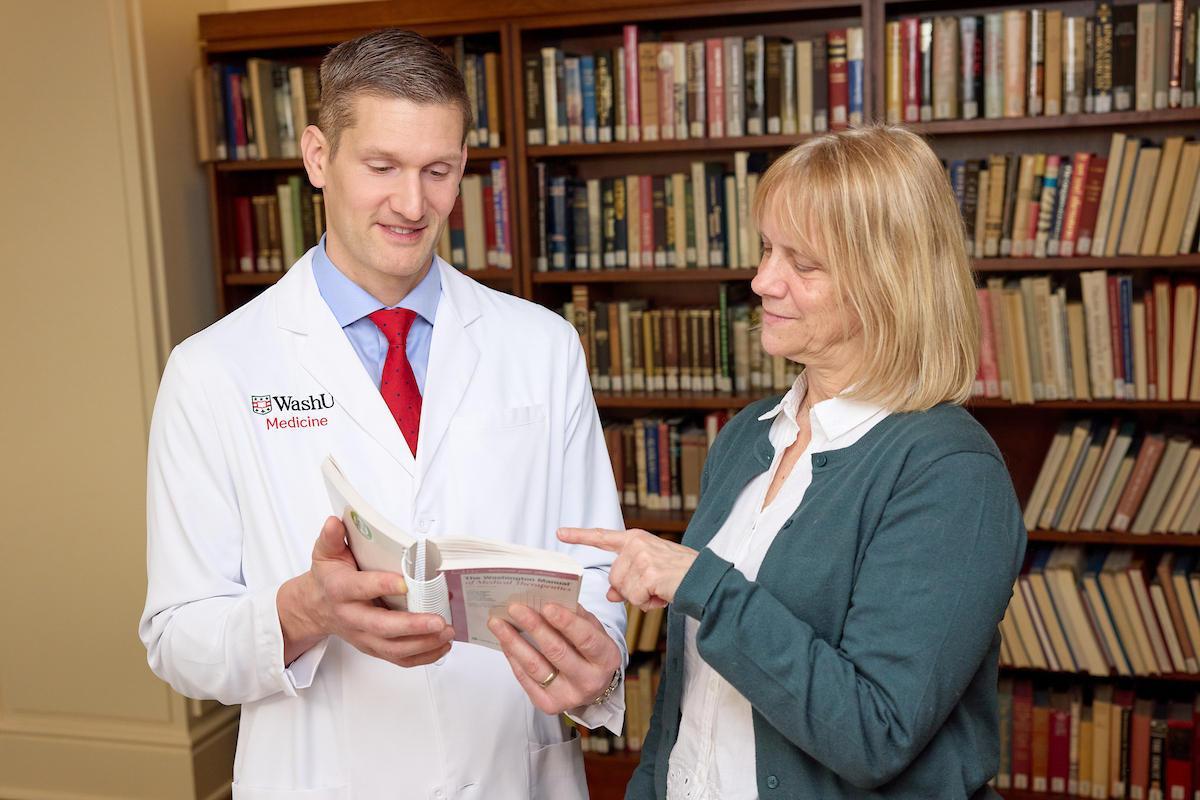 Matt Miller/WashU Medicine
The resident’s clinical compass
Francis Loh, MD, trained as a student and resident at WashU Medicine and is now an instructor in the Division of Hospital Medicine. With enthusiasm, Loh and five chief residents in internal medicine began collaborating in August 2023 as editors of the 38th edition of “The Washington Manual of Medical Therapeutics.”
“As a resident, the manual was my clinical compass,” Loh recalled. “With data now infinite, it is easy for learners to get lost in the noise. It has always been a necessity for clinicians to develop a clear, disciplined approach to complex clinical problems. ‘The Washington Manual of Medical Therapeutics’ bridges that gap by providing the framework required for top-tier, individualized medical care.”
Like Loh, Edward Daniel, MD, PhD, an instructor in the Division of Hospital Medicine, was excited to help edit the 38th edition when he was a chief resident in 2023. “’The Washington Manual of Medical Therapeutics’ is a highly respected resource used across the world to guide physicians in their care,” Daniel said. “I wanted to continue building on its legacy.”