
A decade of bold leaps
Dean David H. Perlmutter, MD, reflects on the progress, purpose and future of WashU Medicine
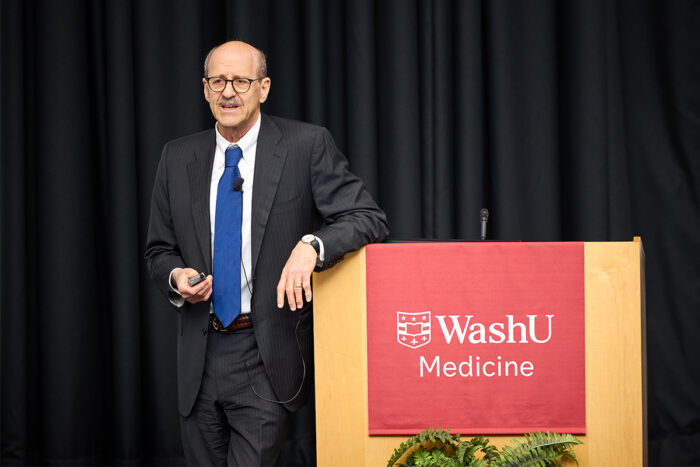
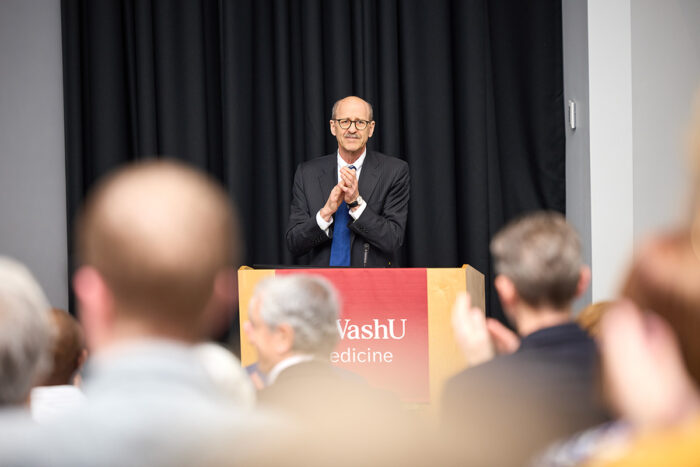
Matt Miller/WashU MedicineWashU Medicine Dean David Perlmutter, MD, gives his annual State of the School address at the Eric P. Newman Education Center on April 10, 2026. Perlmutter, executive vice chancellor for medical affairs and the George and Carol Bauer Dean, will conclude his deanship on June 30, 2026.
After a decade of ambitious growth and transformation, David H. Perlmutter, MD, executive vice chancellor for medical affairs and the George and Carol Bauer Dean of WashU Medicine, delivered his final State of the School address in April, with a message reflecting on remarkable progress and looking confidently ahead.
Standing before faculty and staff at the Eric P. Newman Education Center on the Medical Campus, Perlmutter emphasized the strategic initiatives that elevated WashU Medicine as one of the world’s leading academic medical institutions. In his presentation, “The Courage to Take Great Leaps: Looking Back and Moving Forward,” he outlined the bold steps, shared purpose and relentless drive that shaped WashU Medicine during his tenure, which concludes June 30.
More than a recap of accomplishments, the address was a reminder that everyone in the WashU Medicine community is a “part of something big and meaningful.”
“Across our missions, there is a deep understanding that we are here to make a better world,” said Perlmutter, also the Spencer T. and Ann W. Olin Distinguished Professor. “We do it through teaching the next generation, researching cures for our most devastating illnesses, and caring for the people who come to us every day with the hope that we can do something to improve their lives.”
“All of you have made your own singular contributions to our success,” he added. “We have done this together.”
Over the past decade, that progress has led to measurable and meaningful impact: WashU Medicine rose to No. 2 in research funding from the National Institutes of Health (NIH) — a position it has held for the past three years; reimagined its medical school curriculum into a national model, with a $100 million investment that also expanded scholarship support for students; and expanded clinical care across the region to reach more patients, including those in underserved communities.
At the heart of that progress, Perlmutter said, are WashU Medicine’s unique qualities, including a culture of excellence that has been built over many decades and what he called “generative restlessness” — a drive to keep pushing forward, whether in the face of challenges or times of success.
A shared vision fueled extraordinary growth
Central to WashU Medicine’s rise is the “virtuous cycle of academic medicine,” in which patient care fuels investments and advances in research and education, and they, in turn, improve care, leading to better outcomes for patients and better health for communities. The model connects every part of the institution — and every role within it — around a shared purpose that is closely tied to WashU Medicine’s success.
Investment in people changed what’s possible
Over the past decade, WashU Medicine made deliberate, long-term investments in people, including 17 new department heads, who work as a team to support the school’s ambitious goals, and faculty — including dedicated clinicians and basic research scientists. By recruiting top-tier faculty and supporting their continued growth, the institution strengthened its foundation while expanding its global impact.
The growth rate of faculty at WashU Medicine is more than double the national average at U.S. medical schools, an indicator of the institution’s strength in recruiting faculty. Many are drawn by new research space, which increased by 40% and includes one of the world’s largest neuroscience research facilities, the Jeffrey T. Fort Neuroscience Research Building.
 Matt Miller/WashU Medicine
Expanding care strengthened reach
Clinical growth, including a renewed affiliation agreement with BJC HealthCare, expanded outpatient, community-based care and extended WashU Medicine’s reach across the region. New leading-edge clinical facilities, including the Gary C. Werths Building at Siteman Cancer Center and Barnes-Jewish Hospital’s Plaza West Tower, dedicated to heart and vascular care, not only improved access for patients but also reinforced the institution’s commitment as a safety net provider.
A culture of generative restlessness kept progress moving
From modernizing the MD curriculum to expanding advancing innovation and commercialization, WashU Medicine embraced change in pursuit of better outcomes. That willingness to continuously push forward — paired with a deep commitment to excellence — helped strengthen its standing as a top academic medical institution, even during the pandemic and with challenges to federal research funding.
Reinvention is essential to the health of institutions
Perlmutter credited the past decade’s progress to “a mix of audacity, dedication and brilliant collaboration.” As he prepares to conclude his deanship and return full-time to research on the essential cellular process of autophagy and its role in health and disease, he emphasized that reinvention — “an ability to imagine a new era, even in the midst of success” — is essential to the health of institutions and will carry WashU Medicine forward.
“I am immeasurably proud of the fact that our institution is really good at reinvention,” he said. “And we’re good at it because of all of you. Because you are great at what you do and because you choose to do it here.
 Matt Miller/WashU Medicine