
Blood test powered by AI could transform diagnosis of dementia
New tool can distinguish among major neurodegenerative diseases with goal of providing clarity for treatment decisions
 Sara Moser/WashU Medicine
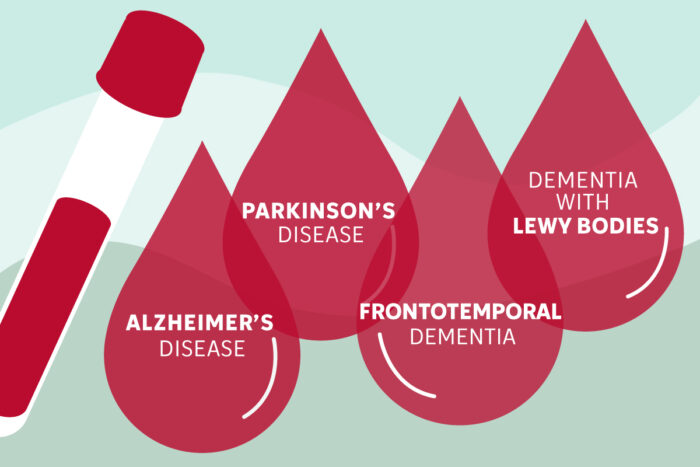
WashU Medicine researchers developed an AI classifier that can accurately distinguish among several major neurodegenerative diseases, including Alzheimer’s, Parkinson’s, frontotemporal dementia, and dementia with Lewy bodies, and detect overlapping brain pathologies, potentially improving early diagnosis, monitoring and personalized treatment.
Many people living with dementia never receive an accurate diagnosis, in part because Alzheimer’s disease, Parkinson’s disease and related conditions are notoriously difficult to tell apart and often occur together. Now, a new tool based on artificial intelligence and a simple blood draw may provide clarity.
Researchers at Washington University School of Medicine in St. Louis have developed an AI-based classifier that distinguishes between four common brain diseases that cause dementia: Alzheimer’s disease, Parkinson’s disease, frontotemporal dementia and dementia with Lewy bodies, as well as healthy brain aging. The tool can separate these diseases from each other and from typical cognitive changes related to aging with over 90% accuracy and can detect when a patient has more than one disease process occurring simultaneously — a common but clinically difficult situation that can complicate treatment.
The findings appear in Alzheimer’s & Dementia.
“Right now, many patients get labeled with a single diagnosis of, say, Alzheimer’s or Parkinson’s, but in reality their brains often show a mixture of disease injuries. Current tools simply weren’t designed to capture that,” said senior author Carlos Cruchaga, PhD, the Barbara Burton and Reuben M. Morriss III Professor in the Department of Psychiatry at WashU Medicine. “Our goal was to build a test that doesn’t just say ‘yes’ or ‘no’ to one disease but instead gives an indication of all the major neurodegenerative diseases happening in that person. That’s what you really need for precision diagnosis and, ultimately, precision treatment.”
A window into the brain
Cruchaga, who also directs WashU Medicine’s NeuroGenomics and Informatics Center, worked with collaborators to create an inexpensive, noninvasive tool that reflects the true biological complexity of the aging or neurodegenerating brain in a way that could support early diagnosis, ongoing monitoring and personalized treatment.
To build the new test, the team selected a set of 15 proteins found in the blood that reflect neurodegenerative pathology in the brain. These included well-validated markers of Alzheimer’s pathology alongside proteins involved in synapse and nerve damage and inflammation.
Cruchaga’s team trained and tested an AI classifier on blood protein data from more than 3,200 individuals collected by the Charles F. and Joanne Knight Alzheimer Disease Research Center and the WashU Medicine Department of Neurology’s Section of Movement Disorders, including people with clinical diagnoses of Alzheimer’s disease, Parkinson’s disease, frontotemporal dementia, dementia with Lewy bodies and cognitively normal controls.
The model’s performance was then verified on a separate group of 225 individuals who were cognitively evaluated during life and had their brains examined at autopsy. The classifier’s outputs aligned closely with the actual pathological burden found in brain tissue and the clinical presentation of dementia when the individuals were living. The tool achieved an overall diagnostic accuracy of 92.3%, appropriately identifying cases when a patient had been diagnosed with a single neurodegenerative disease.
The test also showed promise in providing insights to cases when the diagnosis had been uncertain or evolving.
For instance, in people who had mild cognitive impairment and for those with “other” or ambiguous neurological diagnoses, the model’s prediction for having Alzheimer’s closely matched the actual burden of amyloid plaques — protein clumps in the brain that play a role in cognitive decline — found at autopsy.
The model also identified Alzheimer-like biological changes in people who carried a Parkinson’s diagnosis during life but later developed dementia, underscoring its ability to detect mixed pathology that clinical assessment alone would miss.
The test is not yet ready for clinical use. Cruchaga noted that further validation in larger, more diverse populations is needed to confirm its generalizability, and prospective studies tracking patients over time will be required to assess how well it predicts disease progression and guides treatment.
But the potential applications are broad.
In research, a blood-based multi-disease classifier could help identify the right patients for clinical trials targeting specific disease pathways and enable large-scale population studies that would be impractical to conduct with costly brain scans or spinal taps.
In the clinic, the tool could help physicians decide which patients need further follow up, which specialists they should see, and, ultimately, which treatments or preventive strategies might be most effective.