



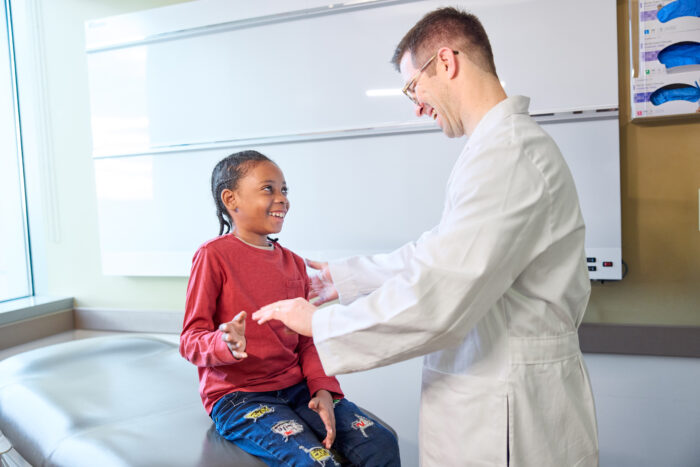
Jaylanie’s journey: Six specialties, one remarkable outcome
Back home in St. Lucia, an island country in the Caribbean, Jaylanie is an 11-year-old known for playing soccer, excelling in math and looking out for his younger sisters. For nearly three years, he was quietly living with something no one around him could explain: a rare, painful tumor destroying his collarbone.
“The first thing that you’re struck by when you meet Jaylanie is his eyes, and just the depth of his personality that you can see in a single gaze,” said David Clever, MD, PhD, WashU Medicine musculoskeletal oncologist and lead surgeon on Jaylanie’s case. “He also has an infectious smile and a very emotive face. Jaylanie can’t hide anything — he wears it emotionally, which is actually quite refreshing, especially in dealing with a young person.”
Jaylanie’s unmistakable openness would carry him through a diagnosis few physicians encounter, and a 10-hour surgery that required four specialized surgeons working as one.
From St. Lucia to St. Louis
Jaylanie’s path to St. Louis began on one of the roughly 30 medical mission trips WashU Medicine pediatric orthopedic specialist Eric Gordon, MD, has made with the World Pediatrics organization. Gordon met Jaylanie at a clinic in St. Lucia, where local physicians had biopsied a mass on his clavicle.
The case didn’t fit a clear pattern. “Tumors in the clavicle in kids are unusual,” Gordon said. To help identify what Jaylanie had, Gordon sent imaging to his colleague Clever and suggested a second, more targeted biopsy. “It’s great to be able to do something like that, because this is an unusual tumor, and yet we have access to people who treat unusual tumors here at WashU Medicine,” Gordon said. That set a global network in motion to bring Jaylanie to St. Louis — a lot to ask of a then 10-year-old who had never stepped foot in America.
Naming a rare diagnosis
By the time Jaylanie arrived in the care of WashU Medicine physicians at St. Louis Children’s Hospital, his body showed the toll of years fighting the tumor. “His inflammatory markers were sky high,” recalled Amy Armstrong, MD, pediatric oncologist. “He was really small. He was anemic. His platelet count was through the roof. Something’s going on here. And it needs to be fixed.”
Armstrong worked with pathologist John Chrisinger, MD, to identify an angiomatoid fibrous histiocytoma — an exceptionally rare cancer finding. “These are really rare tumors, low-grade, slow growing,” she said. “The main thing we can do is just take it out.” It was good news wrapped in a frightening diagnosis: curable through surgery alone, no chemotherapy required — if it could be done safely, given the tumor’s location.
Multidisciplinary collaboration
“The complicating factor was the location,” said vascular surgeon Westley Ohman, MD. “The tumor was directly adjacent to structures that provide blood supply and nerve function to Jaylanie’s arm. That’s why we needed the multidisciplinary experience here at WashU Medicine.”
Over 10 hours, WashU Medicine’s orthopedic, vascular, plastics and oncology teams worked in parallel to remove the tumor and rebuild Jaylanie’s collarbone using bone from his own leg.
“Collaboration is an expectation, not an exception here,” Clever said. While he and Ohman removed the tumor, orthopedic surgeon David Brogan, MD, and plastic surgeon Mitchell Pet, MD, harvested bone from Jaylanie’s leg. “It was almost like a ballet,” Ohman recalled. Reconnecting the transplanted bone required microsurgery at a remarkable scale. “Those blood vessels are one to 2.5 millimeters in diameter — tiny little pipes,” Brogan said. “We hook them together with a suture smaller than a human hair.”
Signs of healing
For Jaylanie, recovery came fast. “On day three, there he was, sitting upright in bed, ordering his fourth hot dog for breakfast,” Clever said. “That gave me that sigh of relief — Jaylanie is back.” Within a month, his inflammatory markers had nearly normalized. “If Jaylanie hadn’t received surgery, I really worry about what his life could have been,” Armstrong said.
Jaylanie spent weeks recovering at the Ronald McDonald House, where he saw snow for the first time and celebrated his birthday with visits from local NHL and MLS team members from the St. Louis Blues and St. Louis CITY SC. “He’s an exceptional kid, and we’re very optimistic about his future,” Clever said.
A bright future ahead
Today, back in St. Lucia, Jaylanie moves without pain and reports, with total confidence, that he’s “the best one on the pitch.” He imagines becoming a PE teacher, passing on his love of the game.
Gordon, who sees Jaylanie again this February in St. Lucia, calls him a success story. “That’s the reason we go down there,” he said, “to make these kids better.” WashU Medicine’s team will continue monitoring Jaylanie’s health for the next 10 years — making sure he simply gets to be a kid.