
Aid for brain-bleed recovery receives FDA Breakthrough Device Designation
Earbud-like device from WashU startup Aurenar is designed to improve stroke outcomes after ruptured brain aneurysm
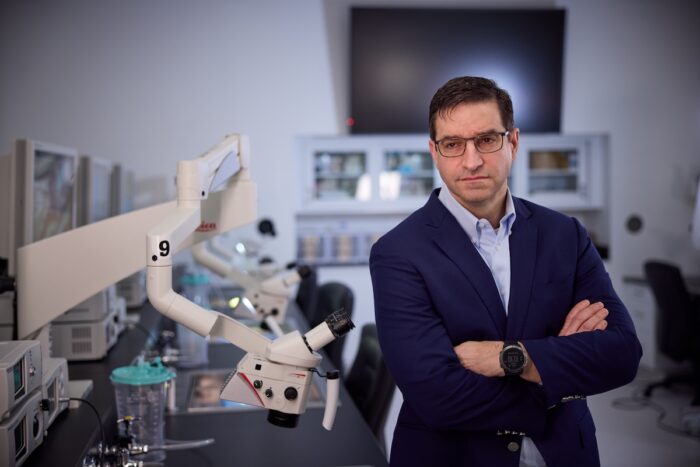 Matt Miller/WashU Medicine
An earbud-like device developed by Aurenar, a WashU startup company, has received FDA Breakthrough Device Designation for preventing a dangerous complication of brain bleeding in intensive care patients. The technology is based on clinical trials led by WashU Medicine physician-scientists including Eric Leuthardt, MD.
A non-invasive neuromodulation technology has received Breakthrough Device Designation from the U.S. Food and Drug Administration (FDA) for reducing a dangerous narrowing of blood vessels in the brain that can follow a brain bleed from a ruptured aneurysm. Early clinical trials led by physician-scientists at Washington University School of Medicine in St. Louis show that the method, which originated from their research, can reduce inflammation and improve outcomes in these very sick intensive care patients. The device, which stimulates a nerve when applied to the outer ear, was developed by Aurenar, a WashU startup company.
FDA Breakthrough Device Designation provides an expedited review process for market approval of promising medical technologies. Devices that earn the designation have shown clinical promise in improving the treatment or diagnosis of severe, life-threatening conditions.
Aurenar’s device, called V-Link System, is designed to reduce inflammation in the critical hours following a hemorrhagic stroke — specifically, bleeding after the rupture of a brain aneurysm, known as subarachnoid hemorrhage. This inflammation is thought to drive a second wave of complications, such as when irritated blood vessels spasm and constrict. This phenomenon, known as cerebral vasospasm, can lead to further brain damage.
“Stroke is not only the second leading cause of death, but a significant contributor to long-term disability,” said Eric Leuthardt, MD, the Shi Hui Huang Professor of Neurological Surgery at WashU Medicine and founder and CEO of Aurenar. “The non-invasive device shows promise in reducing complications and improving outcomes in critically ill patients. Furthermore, we have promising evidence that the intervention reduces intensive care unit costs.”
If the device is approved, patients typically would receive V-Link treatment to the outer ear for 20 minutes twice daily during their approximately two-week ICU stay. The device is designed to tone down the body’s inflammatory response by sending low-energy electrical pulses to a branch of the vagus nerve. The vagus nerve is a major neural highway running from the brain through the neck, chest and abdomen and regulating vital organ functions such as heart rate, digestion and metabolism. The treatment — known as transauricular branch vagus nerve stimulation — stimulates the only branch of the vagus nerve that reaches the surface of the skin, which is in the outer ear.
The technology is based on clinical trials led by Anna Huguenard, MD, and Leuthardt at Barnes-Jewish Hospital, where they treat patients. Huguenard is a WashU Medicine assistant professor of neurosurgery and cofounder of Aurenar. In a clinical trial of 27 patients who had suffered a brain bleed following an aneurysm, the researchers and their collaborators found that delivering electrical pulses in the ear to activate the transauricular branch of the vagus nerve reduced inflammation and mitigated serious complications, including a 40% reduction in vasospasm, with no adverse events. Notably, patients treated with such stimulation also had lower levels of toxic inflammatory chemicals, known as cytokines, in their blood and brain fluid, compared with patients who received the standard of care alone. After 90 days, patients receiving the ear stimulation experienced less disability and were less likely to be readmitted to the hospital or go to a skilled nursing facility.
According to an additional health economic study in collaboration with Barnes-Jewish Hospital, the treatment was also associated with lower healthcare costs due to fewer medical complications, shorter hospital stays and fewer hospital readmissions.
A second clinical trial in stroke patients with large vessel occlusions — where a major vessel supplying blood to the brain becomes blocked — adds hope for future impact. WashU Medicine researchers, including Jin-Moo Lee, MD, PhD, the Andrew B. and Gretchen P. Jones Professor of Neurology and head of the Department of Neurology, and Osvaldo Laurido-Soto, MD, an assistant professor of neurology, also found that ear stimulation was associated with lower levels of inflammatory chemicals that correlated with reduced disability when compared with patients who received standard of care alone.
Aurenar received early support from the Office of Technology Management (OTM), including a collaborative effort to provide a seed grant alongside the WashU Skandalaris Center for Interdisciplinary Innovation and Entrepreneurship to get the company started, and early investment from BioGenerator Ventures and WashU Olin Business School faculty helped the company launch. The company was also supported through a National Science Foundation grant that funded Neuro360, a hub of partners from academia, industry, community and venture capital, led in part by WashU, whose mission is to build infrastructure and networks in St. Louis around neurotechnology.
“The Breakthrough Device Designation validates WashU Medicine’s innovative efforts to treat the most vulnerable patients in the ICU,” said Nichole R. Mercier, PhD, assistant vice chancellor and managing director of OTM. “It highlights exactly why commercialization matters at WashU — where entrepreneurship is turning lab discoveries into real-world medical solutions that impact the daily lives of people.”