

WashU announces new academic-industry collaboration with Bristol Myers Squibb
Multiyear program will provide hands-on training at the pharmaceutical company, fund translational neuroscience research at WashU
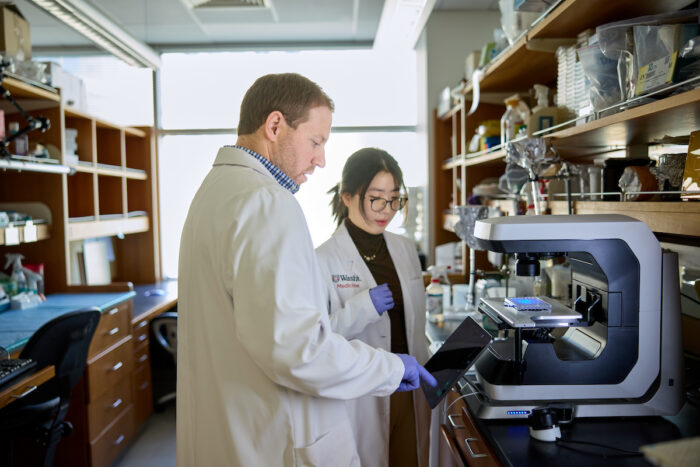 Matt Miller/WashU Medicine
WashU and Bristol Myers Squibb have formed a multiyear collaboration to advance drug development projects in the neurosciences. WashU medical and research trainees will have opportunities to work with Bristol Myers Squibb scientists at the company’s facilities as part of the agreement.
Washington University in St. Louis and Bristol Myers Squibb have formed a multiyear collaboration to foster scientific exchange between academia and industry in the field of neuroscience. Through this agreement, WashU medical and research trainees will have opportunities to work alongside Bristol Myers Squibb teams on select drug development projects.
The collaboration builds on a longstanding research relationship aimed at combining WashU’s expertise in fundamental and clinical research in neurodegenerative diseases with Bristol Myers Squibb’s extensive experience in drug discovery and development. It will also provide unique opportunities for WashU Medicine trainees to gain embedded industry experience.
“This partnership represents a powerful model for how academia and industry can work together to advance neuroscience,” said Doug E. Frantz, PhD, WashU’s vice chancellor for innovation and commercialization. “By pairing our strengths in fundamental and clinical neuroscience with Bristol Myers Squibb’s deep expertise in drug development, we have an opportunity to accelerate breakthrough discoveries toward meaningful therapies for patients. At the same time, integrating our residents and fellows within Bristol Myers Squibb ensures we are training the next generation of physician-scientists in the full continuum of translational science.”
Each year, the program will provide funding to support up to three visiting fellows at Bristol Myers Squibb and three translational research programs at WashU in the neurosciences, with the goal of developing potential new therapeutics for neurological, neuromuscular, neuroinflammatory and psychiatric conditions.
“This collaboration reinforces our commitment to working together with the goal to advance innovation that can help address significant unmet needs in neurodegenerative and neuropsychiatric diseases,” said Peter Paine, Head of Strategic Partnerships for Bristol Myers Squibb. “These conditions represent some of the greatest health challenges of our time, and we look forward to working with WashU to pursue transformational treatments for patients.”
WashU faculty have long collaborated with Bristol Myers Squibb on specific studies or within larger academia-industry initiatives such as the Neurofilament Light Consortium, a collaboration among WashU Medicine, University College London and several pharmaceutical companies, including Bristol Myers Squibb, to investigate neurodegenerative diseases. The new collaboration creates a formal structure to form and fund research projects in priority areas for both WashU and Bristol Myers Squibb. The goal of the agreement is ultimately to advance the field of neuroscience in ways that lead to improved treatments and patient outcomes.
Private-sector partnerships with universities are usually narrow in scope, funding a pre-defined set of projects. In contrast, the high-level joint commitment of this new collaboration focuses on training the next generation of leaders in neuroscience to be proficient in both academic and industry settings.
Melanie Roewe, associate vice chancellor of research administration at WashU, said that the mutual enthusiasm was reflected in the speed and ease with which the agreement came together.
“This is an elevated relationship, different from most collaborations,” said Roewe. “Both sides are invested in finding new and productive ways to work together and continually furthering what this collaboration can achieve.”
Program participation
Individuals interested in participating in the visiting fellows program or the translational neuroscience research program are encouraged to submit an expression of interest by Sept. 1, 2026. For additional information regarding eligibility, participation and the expression-of-interest process, please reach out to Mark Van Horn, Senior Director of Business Development, Strategic External Projects and Outreach: markv@wustl.edu.