
Bateman and Holtzman receive 2026 American Innovator Award
WashU Medicine neurologists honored for blood-based Alzheimer’s diagnostic test
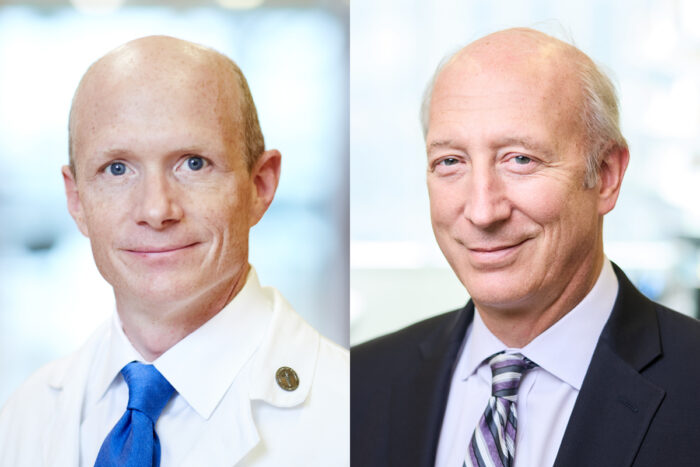 Matt Miller/WashU Medicine
WashU Medicine neurologists Randall J. Bateman, MD, (left) and David M. Holtzman, MD, received the 2026 American Innovator Award for their pioneering work developing blood-based diagnostic tests for Alzheimer’s disease.
Two WashU Medicine researchers whose decades of collaboration transformed Alzheimer’s disease diagnosis have been selected to receive the 2026 American Innovator Award from the Bayh-Dole Coalition. The award honors researchers, entrepreneurs and technology professionals who exemplify the determination required to move a federally funded discovery from the laboratory to the marketplace, where it can improve the lives of millions.
Randall J. Bateman, MD, the Charles F. & Joanne Knight Distinguished Professor, and David M. Holtzman, MD, the Barbara Burton and Reuben M. Morriss III Distinguished Professor, both in WashU Medicine’s Department of Neurology, were honored for their groundbreaking work developing diagnostic blood tests for Alzheimer’s disease.
“Drs. Bateman and Holtzman have reshaped the landscape of Alzheimer’s research and care,” said Jin-Moo Lee, MD, PhD, the Andrew B. and Gretchen P. Jones Professor of Neurology and head of the WashU Medicine Department of Neurology. “By uncovering how the disease develops in the brain and translating those discoveries into a simple blood test, they have made it possible to detect Alzheimer’s earlier, more accurately and far less invasively.”
Bateman and Holtzman pioneered the first methods for detecting Alzheimer’s disease in living patients through blood and cerebrospinal fluid rather than neuroimaging — work that grew out of more than three decades of foundational neuroscience research at WashU Medicine. During that time, Holtzman’s lab showed how the APOE gene, the strongest known genetic risk factor for Alzheimer’s, influences the accumulation and clearance of amyloid in the brain as well as how it influences tau-mediated neurodegeneration; developed plasma and cerebrospinal fluid biomarkers for the disease; and demonstrated that the sleep-wake cycle affects levels of both amyloid beta and tau. Holtzman also discovered how microglia, the brain’s resident immune cells, interact with T cells, another type of immune cell, to drive the neurodegeneration caused by tau accumulation.
Bateman pioneered Stable Isotope Labeling Kinetics (SILK), a mass spectrometry technique that can track protein production and clearance in the human central nervous system with exceptional sensitivity. Applying SILK to Alzheimer’s research, Bateman’s lab then demonstrated that amyloid clearance is impaired in Alzheimer’s disease. Based on this research, his lab discovered the first highly accurate blood test for Alzheimer’s disease used in patient clinics. Since then, Bateman’s lab discovered several more unique blood tests including the most accurate tests available in clinic today. These tests, based on novel forms of tau in the cerebrospinal fluid and blood, can diagnose and stage Alzheimer’s years before symptoms appear — a critical advance toward making screening widely accessible.
Those discoveries laid the scientific groundwork for PrecivityAD, the first blood-based diagnostic test for Alzheimer’s disease, now marketed by C2N Diagnostics — a St. Louis startup co-founded by Bateman and Holtzman. Validated across multiple international cohorts, PrecivityAD has demonstrated high accuracy in detecting early signs of the disease, which could one day make it a tool for routine screening. Bateman and Holtzman are inventors on the foundational patents that WashU licensed to C2N to bring the technology to patients.
The American Innovator Award is given annually by the Bayh-Dole Coalition, a group of organizations and individuals committed to protecting the Bayh-Dole Act of 1980. This revolutionary legislation transformed technology transfer —the process by which scientific discoveries are commercialized — by allowing academic institutions to own the inventions they make with government funding, ensuring more research discoveries can move from the lab to market.
Bateman and Holtzman are featured in the Bayh-Dole Coalition’s 2026 Faces of American Innovation report published May 11. They will be honored at an award ceremony in Washington, D.C., on June 3.