
Bateman, Horie recognized for method to detect, stage Alzheimer’s disease
Morby Prize from Cure Alzheimer’s Fund honors advances toward precision medicine, refined diagnosis
 Matt Miller/WashU Medicine
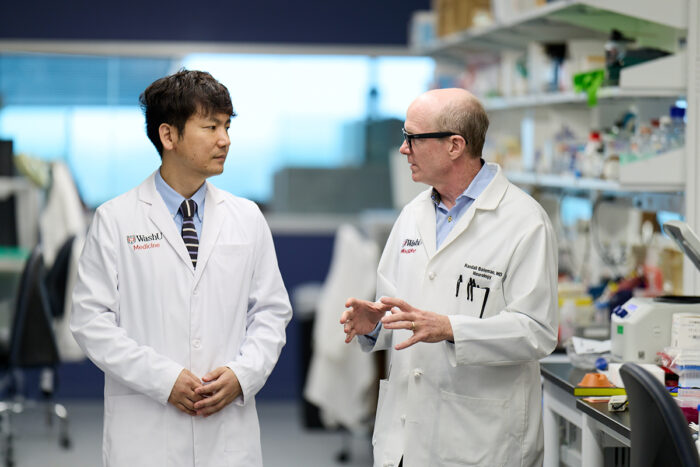
Kanta Horie, PhD, (left) and Randall J. Bateman, MD, received the 2026 Jeffrey L. Morby Prize from Cure Alzheimer's Fund for developing a blood test that detects and stages Alzheimer’s disease by measuring toxic proteins in the brain.
WashU Medicine researchers Randall J. Bateman, MD, and Kanta Horie, PhD, received the 2026 Jeffrey L. Morby Prize in recognition of their groundbreaking 2025 paper describing a blood test that not only detects Alzheimer’s disease but also reveals how far it has progressed.
Bateman, the Charles F. and Joanne Knight Distinguished Professor of Neurology, and Horie, a research associate professor of neurology, share the prize with collaborators Oskar Hansson, MD, PhD, and Gemma Salvadó, PhD, of Lund University in Sweden. Now in its third year, the annual Morby Prize is awarded by Cure Alzheimer’s Fund, a nonprofit that supports research on Alzheimer’s disease, to the senior and first authors of a recent scientific publication that transforms the fundamental understanding of the neurodegenerative condition and opens new paths to preventing, diagnosing or treating Alzheimer’s.
Bateman, Horie and their co-authors were recognized for their 2025 paper, published in Nature Medicine, showing that a specific fragment of tau protein in the blood, eMTBR-tau243, can reliably reveal the toxic tau tangles that drive Alzheimer’s symptoms — the first blood test able to do so. Levels of eMTBR-tau243 in the blood reflect tau tangle accumulation in the brain with 92% accuracy, and the test cleanly separates people with early-stage Alzheimer’s from those with advanced dementia and from people whose cognitive symptoms stem from other causes.
Until now, measuring tau tangles has required expensive brain PET scans that are rarely available outside major research centers. An accessible blood-based alternative could help doctors confirm an Alzheimer’s diagnosis in a person with cognitive symptoms, stage the disease and match the patient to the therapies most likely to help them. These are critical advantages as new drugs targeting tau tangles become available to patients.
“The Morby Prize for our collaborative effort to bring tau tangle blood biomarkers to researchers, doctors and patients acknowledges the incredible impact and promise of being able to detect and measure Alzheimer’s pathology in the brain,” Bateman said. “This advanced test is already being used in clinical trials and research studies, and in the future should be available clinically to benefit patients and families.”
The recognition marks the third consecutive year that WashU Medicine researchers have received the Morby Prize.
The 2025 prize honored Andrew S. Yoo, PhD, the Philip and Sima K. Needleman Distinguished Professor in the Edward Mallinckrodt Department of Developmental Biology, and Zhao Sun, PhD, a former staff scientist in Yoo’s lab, for a novel method to study aged neurons in the lab without a brain biopsy.
The inaugural 2024 prize went to David M. Holtzman, MD, the Barbara Burton and Reuben M. Morriss III Distinguished Professor in the Department of Neurology, and Xiaoying Chen, PhD, a former postdoctoral research associate in Holtzman’s lab, for their discovery of the role of immune cells in neurodegeneration.