
Four early-career physician-scientists selected as Dean’s Scholars
Program supports outstanding WashU Medicine faculty committed to research and patient care
 WashU Medicine
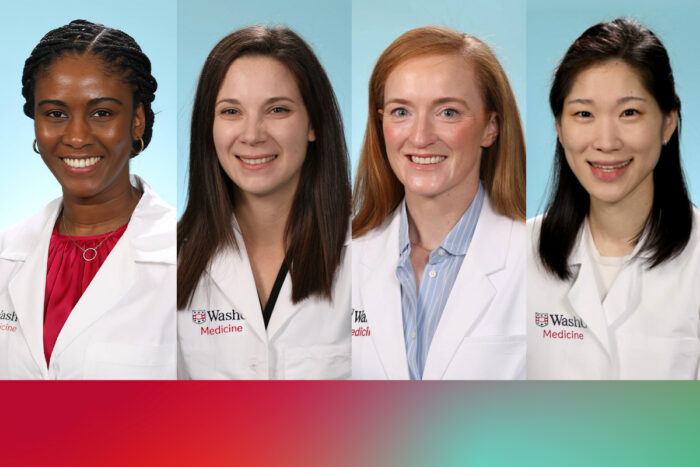
The Division of Physician-Scientists at WashU Medicine has named its seventh class of recipients for the Dean’s Scholars Program. The awardees will receive up to two years of financial support and mentorship, as well as dedicated lab time to conduct scientific research. (From left) Kay Brathwaite, MD; Grace Niziolek, MD; Ruth Tevlin, MD; and Joy Um, MD.
Physician-scientists who split their time between patient care and research are key to advancing diagnosis and developing new treatments. To support faculty members in balancing these pursuits and to help address a nationwide shortage of physician-scientists, David H. Perlmutter, MD, executive vice chancellor for medical affairs, the Spencer T. and Ann W. Olin Distinguished Professor and the George and Carol Bauer Dean of WashU Medicine, initiated the Dean’s Scholars Program in 2020.
The program supports early-career physicians without PhDs as they conduct biomedical research and provides up to two years of funding, dedicated mentorship and protected time in the lab.
The WashU Medicine Division of Physician-Scientists recently announced its newest class of scholars. They are Kaye Brathwaite, MD; Grace Niziolek, MD; Ruth Tevlin, MD; and Joy Um, MD.
“Many of the most important advances in medicine begin with observations made while caring for patients,” said Perlmutter. “Physician-scientists are uniquely positioned to bridge clinical care and scientific discovery by translating unmet patient needs into research questions and research findings into better treatments. Through the Dean’s Scholars Program, we’re investing in exceptional faculty whose work will advance knowledge, improve lives and help shape the future of medicine.”
The program is funded by the dean’s office and departments.
WashU Medicine’s investment in the scholars has had a strong return: According to the Division of Physician-Scientists, every dollar the Division contributes has been followed by more than six additional dollars in further grant funding. The program has also helped scholars move quickly into the next stage of their careers: Within one year of completing the program, 56% have secured major career development awards such as NIH K08 grants, and that figure rises to 82% within two years.
2026 Dean’s Scholars
Brathwaite, an instructor in the Edward Mallinckrodt Department of Pediatrics’ Division of Nephrology, Hypertension & Apheresis, studies how kidney cells called podocytes are damaged in Alport syndrome, a genetic kidney disease that can lead to kidney failure. She uses mouse models and advanced imaging to understand the disease’s molecular changes, including how the kidney processes fat for energy. The knowledge may help to identify new treatments.
Niziolek, an assistant professor in the Mary Culver Department of Surgery’s Section of Acute & Critical Care Surgery, focuses on how severe injury and septic shock can damage blood vessels and lead to long-term conditions such as organ dysfunction, memory problems and poor recovery.
Tevlin, an assistant professor in the Department of Surgery’s Division of Plastic and Reconstructive Surgery, studies how craniofacial bones heal and regenerate after surgery, injury or disease. Her research examines how mechanical forces activate the body’s own repair programs, including skeletal stem and progenitor cells, blood vessels, immune signals, and surrounding tissues such as the dura and periosteum. Her goal is to translate these discoveries into more predictable, biologically informed surgical approaches that help children and adults heal better and achieve durable long-term outcomes after cleft palate and craniofacial surgery.
Um, an attending physician specializing in internal medicine and pediatric rheumatology in the John T. Milliken Department of Medicine and the Edward Mallinckrodt Department of Pediatrics, respectively, studies juvenile spondyloarthritis — an autoimmune disease that causes painful joints in children — to understand its causes and how to detect the disease earlier. In particular, she focuses on T cells, a type of immune cell, and how signals from the gut and infections may confuse the immune system into attacking the body. Um aims to uncover biomarkers and better treatment targets so children suffering from this chronic disease can be diagnosed sooner and treated more effectively.
“Our Dean’s Scholars show that outstanding physician-scientists come from many different training paths — not just the MD/PhD route,” said Wayne M. Yokoyama, MD, associate dean of the WashU Medicine Division of Physician-Scientists and the Sam J. Levin and Audrey Loew Levin Professor of Arthritis Research. “What matters is their commitment to discovery and to improving patient care.”