
Tool to predict brain swelling earns FDA Breakthrough Device designation
First device to identify dangerous stroke complication developed at WashU Medicine
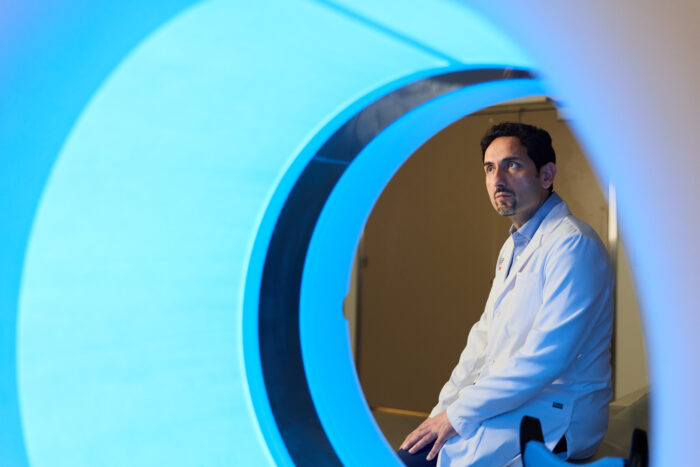 Matt Miller/WashU Medicine
Rajat Dhar, MD, a WashU Medicine professor of neurology, cofounded Beacon-Neuro.AI Inc., a WashU startup that received Breakthrough Device designation from the FDA for an AI-enabled tool to predict dangerous brain swelling in stroke patients. Dhar and colleagues at WashU Medicine developed the technology underlying the prediction platform.
An AI-enabled software tool that predicts the development of dangerous brain swelling after a stroke has received Breakthrough Device designation by the U.S. Food and Drug Administration (FDA). Beacon-Neuro.AI Inc., a Washington University in St. Louis startup, has gained access to technology underpinning the tool, which was developed by researchers at WashU Medicine.
The BeaconPredict software is the first device to predict malignant cerebral edema, a swelling of the brain that can occur in patients who have had an acute stroke. FDA Breakthrough Device designation is given to products that have been rigorously tested and are likely to advance treatment for acute or life-threatening conditions. The designation means that BeaconPredict will undergo an expedited approval process and receive FDA support to meet approval benchmarks.
Malignant cerebral edema affects up to 70,000 stroke patients in the U.S. each year and has a mortality rate of 80% if untreated. This swelling is the leading cause of death in the first week after stroke. Studies have shown that interventions such as surgery are most effective within 48 hours of the stroke and can dramatically reduce the mortality rate of the condition, but clinicians often wait until symptoms are apparent before intervening.
“Malignant cerebral edema is a major killer, but treatments are often not offered until after deterioration has already started, and that is driven by the fact that the available data and decision-making are not very accurate,” said Rajat Dhar, MD, a professor of neurology at WashU Medicine who founded Beacon-Neuro.AI and is the chief scientific and chief medical officer for the company. “BeaconPredict is taking the same data clinicians use and putting it through advanced AI to make that prediction more precise.”
Specifically, BeaconPredict analyzes changes in the brain scans that are taken in the first 24 hours after a patient is admitted to a hospital for stroke. This information is combined with the patient’s blood pressure readings, age, neurological exam results and other data to generate a precise risk assessment of cerebral edema for the clinician.
Dhar said standard clinical approaches for assessing malignant cerebral edema have about a 70% accuracy rate in identifying patients in need of intervention. In contrast, in a recent study, BeaconPredict was 99% accurate in identifying patients in need of surgery to relieve pressure in the brain 24 hours after stroke, when tested on data from 598 stroke patients gathered from three medical centers. Dhar said that the system rarely mistook patients not needing surgery as requiring intervention, achieving a precision rate of 87% — where current methods achieve 50% on the same measure.
Beacon-Neuro.AI, headquartered in Biogenerator Labs in St. Louis, was co-founded with Dhar earlier this year by Jin-Moo Lee, MD, PhD, the Andrew B. and Gretchen P. Jones Professor of Neurology and head of the Department of Neurology at WashU Medicine, and Daniel Marcus, PhD, a professor of radiology at WashU Medicine Mallinckrodt Institute of Radiology. The team also received support from the WashU Office of Technology Management’s Gap Fund program to hire specialists to conduct customer analysis and assist in the application process to the FDA.
“This Breakthrough Device designation is a testament to the value of researchers and clinicians at WashU Medicine being well-positioned to turn their discoveries into innovations that address pressing clinical needs,” said Nichole Mercier, PhD, assistant vice chancellor and managing director of the Office of Technology Management at WashU.
“Dr. Dhar and his colleagues at Beacon-Neuro.AI drew on years of rigorous research and expertise from many different disciplines,” added Mercier. “They had the imagination to tackle a previously intractable challenge in stroke care, and with the funding and support the university provides for advancing innovations like these, their entrepreneurial energy may well transform treatment for thousands of patients.”