
WashU Medicine faculty elected to Association of American Physicians
Pulmonologist Steven Brody and neurologists Jin-Moo Lee and Timothy Miller recognized for excellence in biomedical research
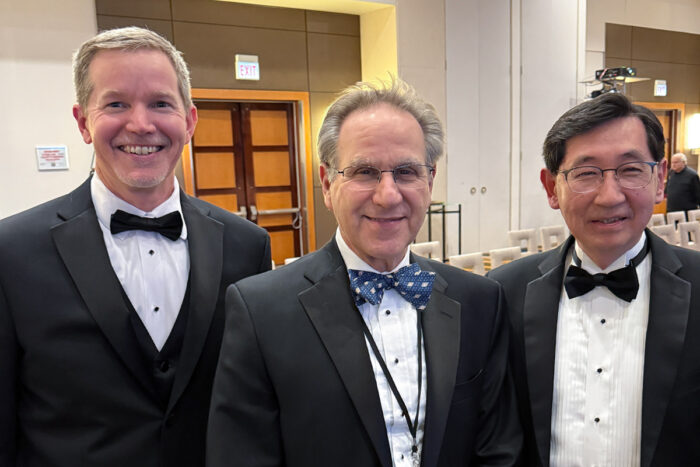 Photo courtesy of Tim Miller
From left, Timothy M. Miller, MD, PhD, the David Clayson Professor of Neurology; Steven L. Brody, MD, the Dorothy R. and Hubert C. Moog Professor of Pulmonary Medicine in the John T. Milliken Department of Medicine; and Jin-Moo Lee, MD, PhD, the Andrew B. & Gretchen P. Jones Professor and head of the Department of Neurology were elected to the Association of American Physicians and formally inducted April 18 in Chicago.
Three physician-scientists at WashU Medicine have been elected to the Association of American Physicians, an honorary society of leading physician-scientists advancing innovative, impactful biomedical research. The AAP fosters physician-led scientific discovery to improve patient care and public health with an emphasis on collaboration and mentorship for early career physician-scientists. The society elected 72 new members in 2026.
WashU Medicine’s 2026 electees are Steven L. Brody, MD, the Dorothy R. and Hubert C. Moog Professor of Pulmonary Medicine in the John T. Milliken Department of Medicine; Jin-Moo Lee, MD, PhD, the Andrew B. & Gretchen P. Jones Professor and head of the Department of Neurology; and Timothy M. Miller, MD, PhD, the David Clayson Professor of Neurology.
Brody investigates how the cells lining the airways malfunction in chronic lung diseases, including asthma, bronchitis, COPD and chronic infections. He has identified key genes that regulate how cilia — tiny hair-like structures that line the airways and sinuses — form and function, including the genes behind primary ciliary dyskinesia, a rare genetic disorder affecting how cilia move, impairing mucus clearance and leading to chronic infections and breathing issues. Brody also studies how airway stem cells are influenced to differentiate into various cell types, including those that make cilia or mucus. In a multidisciplinary effort, Brody and his team are using targeted peptides to deliver therapeutics to the airway and track immune cells in chronic lung disease.
Lee is an internationally recognized leader in stroke and cerebrovascular research with a focus on the cellular and molecular mechanisms of brain injury and recovery. He has shown that sensory deprivation improves recovery after stroke in mice, with translational implications for enhancing brain adaptability in people who have had strokes. Among Lee’s contributions is the advancement of the concept that stroke recovery is associated with the repair of local neuronal circuits as well as global brain networks. Also, collaborating with several multidisciplinary teams, Lee is working to understand the emergence of cerebral small vessel disease, damage to the brain’s tiny blood vessels that can impair blood flow and ultimately lead to cognitive decline, mood changes and physical disability.
Miller’s research focuses on the mechanisms that drive protein abnormalities in neurodegenerative diseases such as ALS and dementia and on developing therapies to counter those processes. He is a pioneer in the development of therapies based on antisense oligonucleotides (ASOs), a targeted approach to disease treatment that interferes with the production of harmful proteins. He led the international clinical trials that resulted in FDA approval of tofersen, the first ASO drug for a rare form of ALS that has been shown to slow or stabilize the degeneration typical of ALS. Building on Miller’s work, ASO therapies are now being tested in people with other neurodegenerative conditions, including Alzheimer’s, Parkinson’s and Huntington’s diseases.
Brody, Lee and Miller were formally inducted April 18 at the annual joint meeting of the AAP, the American Society for Clinical Investigation and the American Physician Scientists Association in Chicago.