
Laser therapy offers weapon against deadly brain tumors
Large analysis of patient outcomes shows that extent of tumor ablation, treatment timing extends survival
 Matt Miller/WashU Medicine
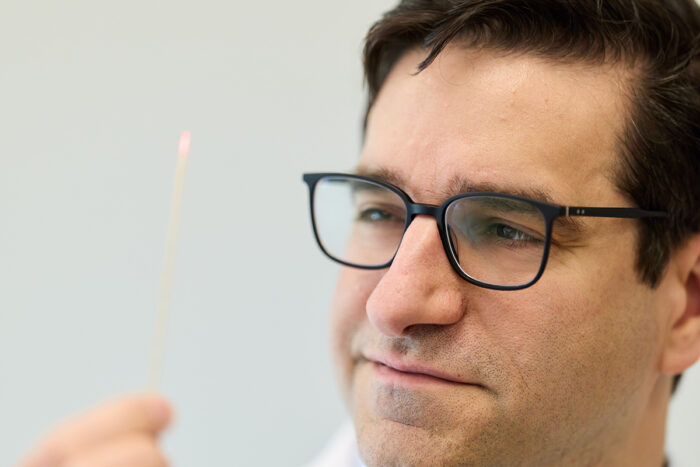
Timing and the extent of tumor removal are critical to improving survival for patients receiving laser interstitial thermal therapy (LITT) for hard-to-reach or inoperable recurrent brain tumors, according to a study led by WashU Medicine neurosurgeon Eric Leuthardt, MD (pictured).
For patients facing a diagnosis of glioblastoma — one of the most aggressive and devastating forms of brain cancer — the standard path forward has long meant an invasive open-skull surgery and a daunting prognosis.
Over the past decade and a half, neurosurgeons have incorporated another treatment approach: a minimally invasive laser treatment — currently offered to patients with recurrent, difficult-to-access, or inoperable brain tumors — that is safe and extends survival by months, a meaningful milestone for people with a terminal diagnosis. Now, an analysis of patient outcomes led by researchers at Washington University School of Medicine in St. Louis found potential ways to enhance these benefits, revealing that the extent of tumor removal by the procedure and the timing of treatment extend survival.
The analysis, published Aug. 17 in the Journal of Clinical Oncology, has the potential to improve clinical care for patients.
“Our goal is to both extend the survival of our brain tumor patients and improve the quality of their lives,” said the study’s principal investigator and lead author Eric C. Leuthardt, MD, the Shi Hui Huang Professor of Neurological Surgery at WashU Medicine and chief of the Division of Neurotechnology, who treats patients at Siteman Cancer Center, based at Barnes-Jewish Hospital and WashU Medicine. “This analysis identifies the factors that lead to the best outcomes. This critical new information will help us find opportunities for patients to benefit the most from this therapy.”
The analysis focused on 787 brain tumor patients who were included in a prospective multicenter study that tracked patients for up to five years after undergoing the minimally invasive laser procedure. WashU Medicine led the study at Siteman Cancer Center and 24 other locations across the U.S.
Factors extending brain cancer survival
Patients diagnosed with glioblastoma and other brain tumors typically undergo an invasive surgery that involves temporarily taking off part of the skull to remove the tumor, often followed by both chemotherapy and radiation.
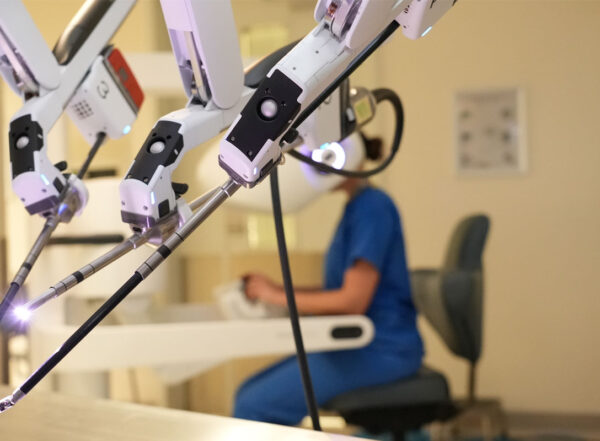
For those with tumors that are difficult or impossible to remove with open surgery, doctors often treat the cancer with a less-invasive intervention known as laser interstitial thermal therapy, or LITT. Neurosurgeons drill a tiny hole in the skull and insert a robotically controlled laser probe guided by real-time MRI that helps doctors steer the probe through the brain to the tumor on a path that avoids healthy tissue damage. Once inside the tumor, the laser emits heat that kills the surrounding tumor cells. The surgical tool, NeuroBlate, was developed by Monteris Medical, a neurosurgical technology company that funded the study. NeuroBlate was cleared for marketing by the U.S. Food and Drug Administration in 2009.
The researchers aimed to use the largest collected cohort of patients receiving laser surgery for brain tumors that originate in the brain or spread from other parts of the body to understand the factors driving successful patient outcomes of the minimally invasive surgery. The study provides actionable data to help physicians determine which patients may benefit most from the minimally invasive procedure.
Among patients with inoperable or recurrent tumors, the researchers found that how much of the tumor is destroyed by the laser is an important factor in how long a patient survives, especially for those with newly diagnosed glioblastoma. Their analysis showed that glioblastoma patients who had at least 91% of their tumor cleared survived 2.1 years from diagnosis. Because survival with standard open surgical resection is approximately 1 1/2 years, this provides essential information for considering NeuroBlate as a tool that can also be used to treat these tumors up front.
“We are shifting the entire framework of how we handle brain tumors. When patients are told they have months to live, having the option of a low-risk procedure that gets them back home to their families in just over a day is profoundly meaningful.” Eric Leuthardt, MD, WashU Medicine
Beyond glioblastomas, the analysis delivered insights for treating brain metastases — cancers that have spread to the brain from other parts of the body — after prior radiation therapy. The data revealed a survival advantage for patients who received laser therapy when the tumors were still small. This insight re-evaluates the common practice of watchful waiting, in which clinicians may wait several imaging cycles to confirm tumor growth. Treating earlier, when the tumor is smaller, yields better outcomes than waiting for the tumor to grow.
Some of the 787 brain tumor patients included in the analysis received laser therapy at Barnes-Jewish Hospital, part of BJC HealthCare. For decades, WashU Medicine and Barnes-Jewish Hospital have pioneered laser neurosurgery. In 2010, Leuthardt performed the nation’s first laser interstitial thermal therapy for a brain metastasis at Barnes-Jewish Hospital following the FDA-clearance of the NeuroBlate surgical tool. This milestone was enabled by early investments from BJC HealthCare in intraoperative MRI capabilities, allowing surgeons to see tissue in real time and make more precise decisions during the operation.
“By combining BJC HealthCare’s premier infrastructure with WashU Medicine’s world-class expertise, patients with brain cancer gain access to the most advanced medical technology available,” said Leuthardt.
Boosting quality of life for brain cancer patients
Aside from extending lives, the study confirmed that the laser treatment impacts the patient experience. Traditional brain surgery requires partial, temporary skull removal and weeks of recovery. In contrast, the laser procedure requires only a single-stitch incision a few millimeters wide.
Consistent with other publications analyzing data from the clinical study, the researchers, including WashU Medicine physician-scientist Albert H. Kim, MD, PhD, the August A. Busch, Jr. Professor of Neurological Surgery and director of The Brain Tumor Center at Siteman Cancer Center, showed that the procedure is well-tolerated, maintains a patient’s day-to-day quality of life and limits the average hospital stay to just 32 hours. Patients recovered quickly and most avoided intensive care and readmission. The procedure also reduced the need for anti-seizure medication compared to before the surgery.
“We are shifting the entire framework of how we handle brain tumors,” said Leuthardt. “When patients are told they have months to live, having the option of a low-risk procedure that gets them back home to their families in just over a day is profoundly meaningful.”