40-year mystery solved: Common gut virus infects bacteria, not human cells
Study redefines picobirnaviruses as only the third known group of bacteria-infecting RNA viruses
 Sara Moser/WashU Medicine
WashU Medicine researchers have rewritten the story on a group of viruses once thought to directly infect human tissue and play a role in gastrointestinal disease. They found that the common virus actually infects gut bacteria, redefining how these viruses impact human health.
In Brief
- Researchers found that picobirnaviruses infect bacteria within the human gut microbiome.
- Only two other groups of RNA viruses are known to infect bacteria.
- The findings open new opportunities to study how these viruses impact human health.
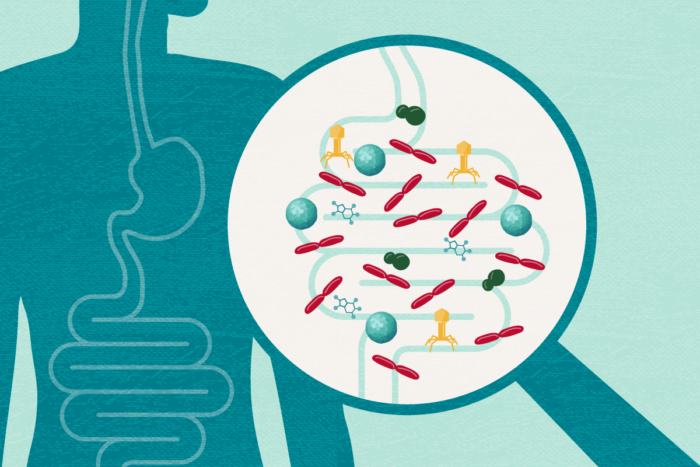
Thriving alongside trillions of bacteria in the human digestive tract is a vast population of viruses. Ever since one such denizen of the gut microbiome, known as picobirnavirus, was first spotted decades ago, researchers thought it directly infected human tissue and played a role in gastrointestinal illness. But researchers at Washington University School of Medicine in St. Louis and collaborators have just rewritten that story: This widespread virus infects gut bacteria, not human cells.
The findings, published Oct. 29 in Nature Microbiology, are a major milestone for the field of virology and redefine picobirnaviruses as only the third known family of bacteria-infecting RNA viruses ever discovered.
“This discovery changes our understanding of the gut ecosystem,” said David Wang, PhD, the Robert C. Packman Professor at WashU Medicine. “RNA viruses that infect bacteria in the human body were thought to be rare. But picobirnaviruses are abundant in the gut and knowing that they infect bacteria is a first step in enabling us to better understand what role they play in causing disease.”
Stomach bug or bacteria hunter?
For nearly four decades, scientists thought they had identified another human stomach bug.
Picobirnaviruses were first described in stool samples from patients suffering from diarrhea, turning up alongside notorious culprits such as rotavirus and norovirus. Without the tools to grow the virus in the laboratory, the researchers assumed the newcomer was directly attacking human cells to cause gastrointestinal misery.
That is, until advances in sequencing technology led the Wang lab to unexpectedly find traces of picobirnavirus genetic material while studying Caenorhabditis elegans, a microscopic roundworm often used in genetics research. Although humans and worms differ in many ways, one commonality is bacteria: Worms eat them, and humans carry trillions of them in their gut.
The researchers asked: Do picobirnaviruses infect bacteria?
First author Tianyu Gan, PhD, a postdoctoral research fellow in Wang’s lab, in collaboration with researchers at Cambridge University Hospitals NHS Foundation Trust, Flinders University and San Diego State University, set out to find the virus inside a bacterial host. He introduced human stool samples to microbe-free mice, establishing the first laboratory model where the virus could actively multiply. Next, Gan and team harvested the viral population from the mouse gut and grew it in lab dishes filled with gut bacteria under oxygen-free conditions. Because mammalian cells cannot survive without oxygen, the virus’ growth over 20 days suggested it was multiplying inside bacteria. Antibiotics that killed off the bacteria also halted the virus from multiplying.
Using advanced molecular imaging and cellular sorting, the researchers found picobirnaviruses inside a newly identified gut bacteria they named Candidatus Anaerotignum faecalis.
The presence of picobirnaviruses in the gut has been linked to clinical conditions including acute diarrhea, graft-versus-host disease (a complication of stem cell transplants) and Type 1 diabetes.
It’s possible that, although picobirnavirus doesn’t infect human cells directly, it could be destroying beneficial gut bacteria. Wiping out friendly microbes disrupts the gut ecosystem, allowing harmful pathogens to bloom and prompting bacteria to release toxins. Moreover, human gut cells can absorb viral particles and spark inflammation, without the virus multiplying inside human tissue.
On the other hand, detecting high levels of picobirnavirus in patients with these conditions does not prove the virus causes disease, Wang warned. Even if it not a pathogen, it could serve as a biomarker, signaling gut distress.
“The first step to understanding how a virus impacts human health is understanding what it infects,” Wang said. “Knowing that picobirnaviruses infect bacteria shifts our focus to the microbiome. It opens new opportunities to study how these viruses shape bacterial communities in the gut and how we might harness them for targeted therapies.”