Genetic study of heart disease reveals new routes to therapies
Innovative approach uncovers how inherited genetic risk leads to coronary artery disease
 In-Hyuk Jung
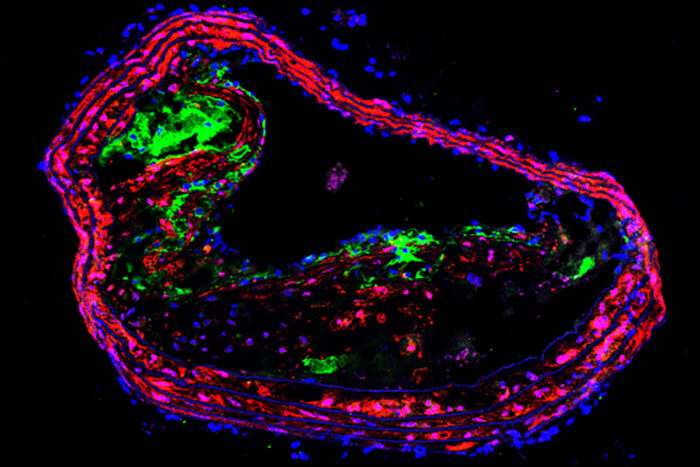
Researchers at WashU Medicine have created a detailed map connecting inherited genetic variants to their practical effects in the coronary arteries. Shown is a cross section of a mouse artery with atherosclerotic plaque, similar to what develops in patients with coronary artery disease. Red indicates vascular smooth muscle cells, and green indicates foam cells, which develop from vascular smooth muscle cells and other cell types that have accumulated excess fat and cholesterol. Cell nuclei are in blue.
In Brief
- Researchers have designed a map that connects genetic variants long associated with coronary artery disease to the genes they impact.
- Targeting the genetics of key cells could lead to new treatments for heart disease.
- The framework could apply to any disease with complex genetic traits.
Researchers have amassed a detailed catalog identifying how specific genetic changes play causal roles in coronary artery disease, a condition in which the vessels that carry blood to the heart narrow or become blocked. The undertaking is the first to connect inherited genetic variants to their practical effects in the coronary arteries, findings that could guide development of new therapies for heart disease.
The research, led by investigators at Washington University School of Medicine in St. Louis, is published Nov. 25 in the journal Nature.
The study is focused on cardiovascular disease, but it describes a new approach for understanding, at the molecular level, any genetically complex condition, such as kidney disease, obesity, diabetes or asthma, according to the investigators. Such molecular insight provides a list of targets for therapeutic intervention.
Common chronic diseases such as coronary artery disease develop via the complex interplay of genetics and environment. Large human genetic studies — called genome-wide association studies — have identified more than 350 inherited genetic changes associated with higher risk of coronary artery disease. Some of these genetic changes are in regions of the genome that carry instructions for making proteins and therefore affect the construction and function of the relevant protein. But for coronary artery disease and other common chronic diseases, nearly all of the associated genetic variants are located in the so-called noncoding regions of the genome, which don’t harbor protein recipes, thereby making it difficult to determine exactly what they do.
That doesn’t mean noncoding regions of the genome are inconsequential. Many noncoding regions have important jobs directing which proteins are produced and when. Genetic changes to these regions therefore can result in cellular dysregulation, but to date there has been no comprehensive directory that ties variants in noncoding regions to the downstream effects in various cell types that ultimately lead to heart disease.
The new study harnesses the most advanced tools of molecular genetics to finally connect the dots between noncoding variants long associated with coronary artery disease and the practical impact these variants have on protein machinery in the coronary arteries.
“We now have a map that connects noncoding genetic variants associated with coronary artery disease to the protein-coding genes and cell types they impact, paving the way for possible new therapeutics,” said senior author and WashU Medicine cardiologist Nathan O. Stitziel, MD, PhD, a professor of medicine and of genetics. “And because the gene mapping approach we employed could be applied to any complex disease, we think this study could be highly impactful for the field of human genetics broadly.”
Solving the mystery of the noncoding regions
The investigators analyzed 44 coronary artery samples from patients undergoing heart transplantation for heart failure. About half of the patients had heart failure due to blocked coronary arteries and half had heart failure due to other causes.
The researchers studied four major cell types present in the coronary arteries: smooth muscle cells, which help the vessels contract; endothelial cells, which line the inside of vessels; fibroblasts, which help provide structure to the vessel; and immune cells, which respond to infections and inflammatory injury.
The researchers found that much of the heritable portion of coronary artery disease risk is in noncoding variants that act on genes in cells of the artery wall, particularly smooth muscle cells. For example, one genetic variant from a noncoding region triggered protein production that caused smooth muscle cells to lose some of their contractile quality, making them stiffer and more inflammatory. Targeting such proteins could lead to new ways to help smooth muscle cells maintain their ability to contract, perhaps keeping the coronary arteries healthier longer.
Stitziel and his colleagues are studying several genes identified in this study in efforts to pursue new therapeutics for coronary artery disease. They’re also analyzing more samples of diseased arteries to expand their current genomic map into a larger and more detailed resource for researchers seeking better treatments for coronary artery disease.