$43 million extends global study of inherited Alzheimer’s disease
Funding from NIH will double participants, explore why some people resist the disease
Huy Mach and Sara Moser/WashU MedicineIn Brief
- A five-year, $43 million NIH award will help double enrollment in WashU Medicine’s global study of inherited, early-onset Alzheimer’s.
- Because symptoms arrive at predictable ages, researchers can map the disease decades early and test prevention drugs.
- Findings could help people at risk for common late-onset Alzheimer’s.
When a parent carries one of the rare gene mutations that cause Alzheimer’s disease to occur at a young age, each child has a 50% chance of inheriting it. Nearly everyone who does will develop dementia, often in their 40s or 50s. For nearly two decades, these families have helped researchers at Washington University School of Medicine in St. Louis turn that predictability into a roadmap of how Alzheimer’s develops, decades before symptoms appear.
This project, known as the Dominantly Inherited Alzheimer Network Observational Study (DIAN Obs), has enrolled more than 750 people since John C. Morris, MD, the Harvey A. and Dorismae Hacker Friedman Distinguished Professor of Neurology, launched it at WashU Medicine in 2008. The study will now expand with a five-year, $43 million award from the National Institute on Aging, part of the National Institutes of Health (NIH). The funding will enable researchers to double the number of participants.
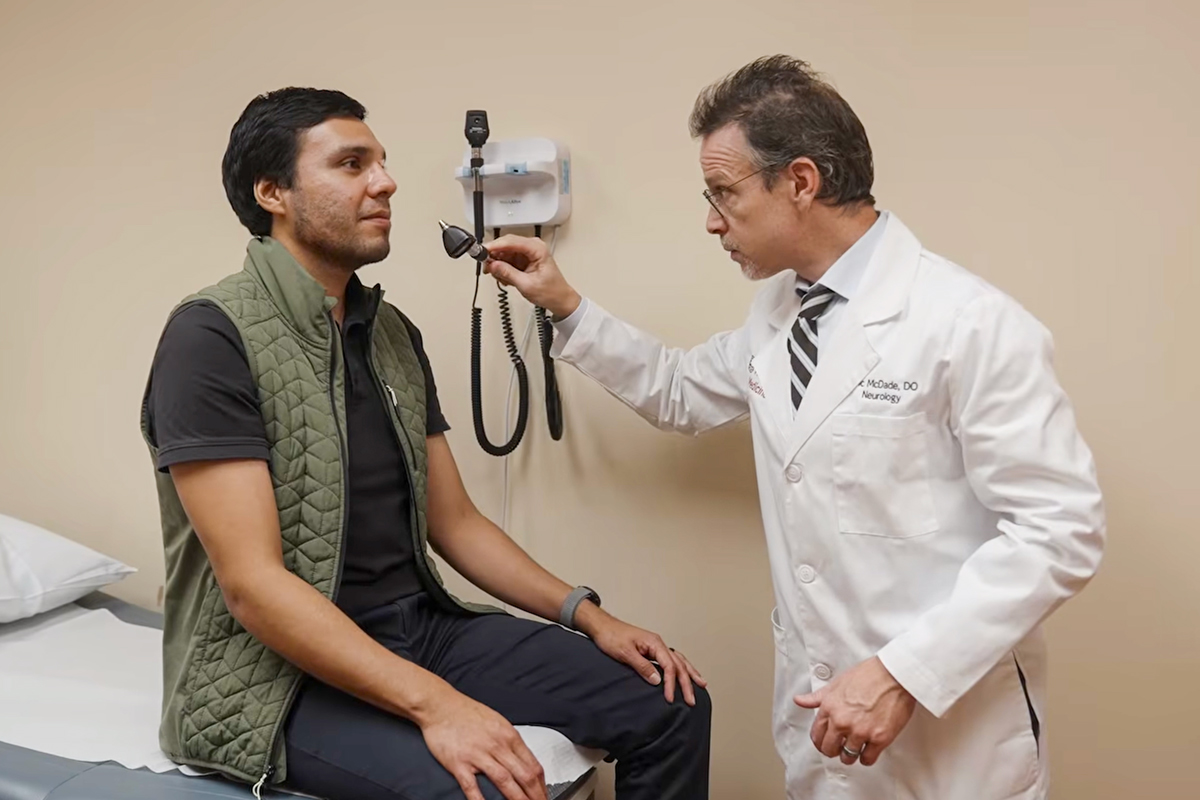
“Because these families can tell us roughly when symptoms are likely to start, we can map how the disease unfolds 20 or more years before memory fails,” said Eric McDade, DO, a professor of neurology and director of the Dominantly Inherited Alzheimer Network. “And because the biology looks remarkably similar to the far more common late-onset form of Alzheimer’s that emerges in older ages, what we learn here can help everyone at risk.”
 Huy Mach and Sara Moser/WashU Medicine
How does the Alzheimer’s project advance the goal of prevention?
The Dominantly Inherited Alzheimer Network is based at WashU Medicine and involves institutions across the U.S. and at sites in 10 other countries. The study gives the same memory tests, brain scans, and blood and spinal fluid analyses to people who inherited the gene mutation and to their relatives who didn’t. About three-quarters of participants had no symptoms when they joined, offering a rare view of Alzheimer’s silent early stages.
“My hope is that Alzheimer’s will go the way of heart disease or high blood pressure, where you get your labs done, and if you’re on that path, you get a drug — hopefully as simple as a pill. I don’t think that’s pie in the sky anymore.”Marty Reiswig, study participant
The observational study was designed to understand how the disease develops and directly supports the Knight Family DIAN Trials Unit, which is focused on finding ways to stop the development of Alzheimer’s and launched its first clinical trial for prevention in 2012. The unit is led by Randall J. Bateman, MD, the Charles F. and Joanne Knight Distinguished Professor of Neurology at WashU Medicine, who directed the network before McDade. While those in the clinical trial receive the intervention, those in the observational study serve as a comparison group because they are not given the experimental drug.
“That design lets us enroll far fewer people and show regulators how a drug alters the disease’s course,” said McDade.
Through the trials unit, McDade is leading an international primary prevention trial, the first to treat people up to 25 years before symptoms are expected. Most participants don’t yet have amyloid plaques — clumps of a toxic protein that are an early sign of Alzheimer’s — in their brains. The trial is testing whether a drug that targets amyloid can keep those plaques from ever forming.
With the new funding, the team will build on a recent expansion into Latin America led by Jorge J. Llibre-Guerra, MD, an associate professor of neurology at WashU Medicine and associate director of the Dominantly Inherited Alzheimer Network. The team will increase the focus on people who inherited the mutation, but who proved resilient to developing symptoms and stayed healthy long past their expected age of onset, to try to identify what is protecting them. They will also track what happens when amyloid stays cleared from the brain for years and prepare for new kinds of treatments that target the genes behind the disease. Importantly, the DIAN Obs study now includes a group of individuals who are being treated with amyloid immunotherapy, some for over 10 years, enabling researchers to monitor how this affects the disease course relative to the natural history.
Why is the study meaningful to families?
Marty Reiswig, 48, has been a participant in the observational study of early-onset Alzheimer’s since 2010. He travels to St. Louis from Denver each year to undergo testing and serves on the study’s steering committee. He is also enrolled in a prevention drug trial. His father, uncle and grandfather all had early-onset Alzheimer’s, but he hopes his participation in the studies means his children and grandchildren won’t have to bear that burden.
 Huy Mach and Sara Moser/WashU Medicine
“Five more years of funding is massive,” Reiswig said. “It’s foundational. What a boon for people in my shoes who are looking for hope and want to be part of good science.
“My hope is that Alzheimer’s will go the way of heart disease or high blood pressure, where you get your labs done, and if you’re on that path, you get a drug — hopefully as simple as a pill,” Reiswig added. “I don’t think that’s pie in the sky anymore.”