
FDA clears blood test to aid evaluation for Alzheimer’s disease
Biomarker test is based on technology developed at WashU Medicine
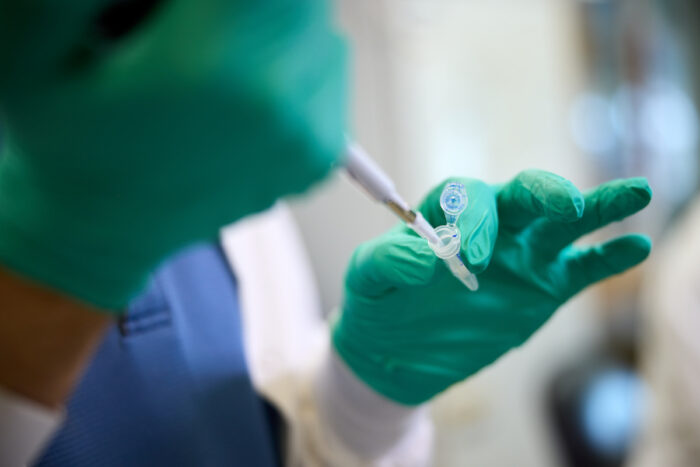 Matt Miller/WashU Medicine
The FDA has cleared a blood test developed from technology invented at WashU Medicine to aid in diagnosing Alzheimer’s disease. The test, PrecivityAD2, can detect amyloid plaque biomarkers with over 90% accuracy, offering a less invasive alternative to spinal taps and brain scans.
The U.S. Food and Drug Administration (FDA) has cleared for marketing an innovative blood test with underlying technology invented at Washington University School of Medicine in St. Louis for the early diagnosis of Alzheimer’s disease. The test, known as PrecivityAD2, was developed and validated by C2N Diagnostics, a WashU startup company.
PrecivityAD2 is a blood-based diagnostic test cleared by the FDA to aid in identifying the presence of amyloid plaques in the brain associated with Alzheimer’s disease in certain patients. Unlike some other FDA-cleared blood-based tests that use immunoassay methods to analyze biomarkers associated with Alzheimer’s, PrecivityAD2 uses high-resolution mass spectrometry to provide quantitative measurements of the biomarkers.
The availability of blood-based biomarker testing may help clinicians evaluate patients for Alzheimer’s disease using a less invasive approach than cerebrospinal fluid testing. Biomarker information may also help inform appropriate clinical management when interpreted together with a patient’s clinical history and other diagnostic information.
Early detection of Alzheimer’s disease is important since the first treatments capable of slowing the progression of the neurodegenerative disease recently became available to patients, and these drugs are more effective when started sooner rather than later. Other promising investigational drugs are in the pipeline.
Fundamental technology underlying the test was initially developed by a WashU Medicine team co-led by Randall J. Bateman, MD, the Charles F. and Joanne Knight Distinguished Professor of Neurology, and David M. Holtzman, MD, the Barbara Burton and Reuben M. Morriss III Distinguished Professor in the Department of Neurology. C2N Diagnostics is a WashU startup co-founded by Bateman, Holtzman and others in 2007. C2N acquired exclusive commercial license rights to the patented technologies developed in Bateman’s and Holtzman’s labs, and optimized and commercialized assays underpinning some of the tests developed by Bateman’s team.
“The PrecivityAD2 test provides an accurate and reliable way to detect the presence of brain amyloid plaques associated with Alzheimer’s disease pathology based on a single blood draw,” Bateman said. “With FDA clearance, this innovation can reach more patients, increasing early and accurate diagnoses for people who are seeking causes of cognitive symptoms such as memory loss. With faster diagnosis, patients can receive earlier treatment, when treatments are most effective.”
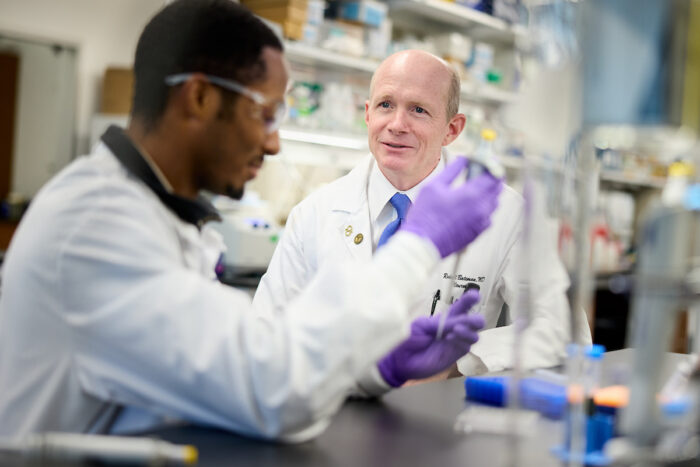 Matt Miller/WashU Medicine
FDA clearance signifies that PrecivityAD2 has undergone rigorous evaluation to confirm it has comparable accuracy to cerebrospinal fluid tests and brain scans, even in patients with mild symptoms. Although physicians have been able to order the PrecivityAD2 test for patients with mild cognitive symptoms, FDA clearance allows PrecivityAD2 to be marketed more broadly to clinicians and health systems that rely upon FDA for quality assurance. Clearance can also facilitate insurance coverage, which makes the test more affordable and accessible.
The blood test uses high-resolution mass spectrometry to measure the ratio of levels of amyloid (Aβ42 and 40) and two forms of tau protein (p-tau217 and total tau217) in the blood. These biomarkers are associated with amyloid pathology, a characteristic feature of Alzheimer’s disease.
Previous studies demonstrated that the PrecivityAD2 test can diagnose the amyloid pathology of Alzheimer’s disease with more than 90% accuracy. It performs comparably to more invasive screening methods such as spinal taps and brain scans, even in patients with mild cognitive symptoms.
Transforming Alzheimer’s diagnosis and management
The PrecivityAD2 test is built on Bateman and Holtzman’s foundational research into Alzheimer’s disease-related amyloid and tau proteins. Their research helped establish methods for precisely measuring Alzheimer’s-associated proteins and investigating their relationship to disease pathology.
Bateman and Holtzman pioneered stable isotope-linked kinetics (SILK) approaches for studying the production and clearance of amyloid-beta in the brain and cerebrospinal fluid. This work contributed to the scientific foundation for subsequent development of blood-based biomarker technologies.
“Achieving FDA clearance of the PrecivityAD2 blood test is a key milestone in our mission to transform the diagnosis and management of Alzheimer’s disease on a path toward finding a cure,” Holtzman said. “This accomplishment reflects the unwavering, yearslong commitment of everyone on our team and the team at C2N Diagnostics to delivering innovative solutions that improve lives.”
 Matt Miller/WashU Medicine
Bateman and Holtzman worked with the WashU Office of Technology Management (OTM) to file patent applications related to components of the blood test, and co-founded C2N to commercialize the Alzheimer’s blood-testing technology. An ongoing expanded research collaboration between WashU Medicine and C2N has helped to accelerate the PrecivityAD2 test’s commercialization.
“The FDA clearance of C2N’s blood test is a significant advancement in Alzheimer’s diagnostics and a testament to the culture of innovation at WashU Medicine,” said Doug E. Frantz, PhD, vice chancellor for innovation and commercialization at WashU. “Accurate and accessible tools like this are critical in supporting our mission to accelerate the development of treatments and cures for Alzheimer’s and other diseases once thought to be untreatable.”
C2N employs more than 120 researchers, physicians and other highly skilled professionals and is expanding its headquarters to St. Louis’ Cortex Innovation District, a 200-acre campus adjacent to WashU Medicine.