
Researchers find a common weakness in major gut pathogens
The discovery could lead to a single vaccine against E. coli, Shigella and other causes of severe diarrhea
 David Hasty
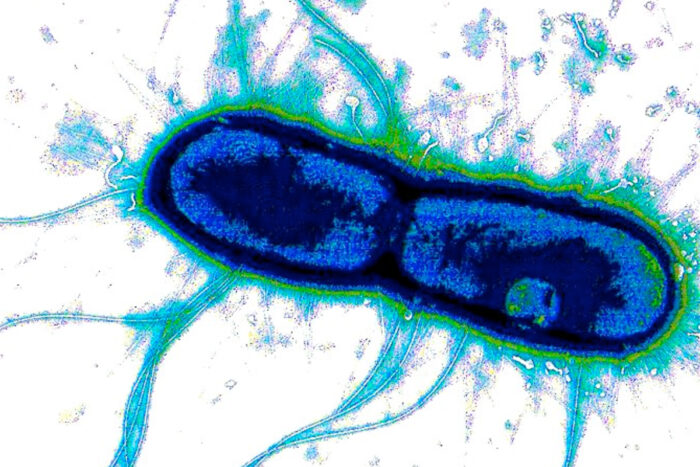
WashU Medicine researchers and collaborators at the University of Missouri identified a shared vulnerability across diarrhea-causing bacteria including E. coli (shown) and Shigella, a finding that could potentially lead to a single combination vaccine against these pathogens.
The bacteria enterotoxigenic E. coli and Shigella together cause hundreds of millions of infections each year and are among the leading causes of diarrheal death, especially in children. Decades of vaccine development efforts have come up short, in part because the usual vaccine targets vary too much from one strain to the next.
New research from Washington University School of Medicine in St. Louis points to a shared biological feature of these gut pathogens that could lead to a vaccine that protects against both.
Researchers at WashU Medicine, along with collaborators at the University of Missouri and the International Centre for Diarrhoeal Disease Research in Bangladesh, found that enterotoxigenic E. coli (the leading cause of travelers’ diarrhea), Shigella and other diarrhea-causing pathogens rely on three closely related enzymes to get through the gut’s protective mucus layer and cause infection. Based on samples from infected patients and volunteers exposed to the bugs, the team showed that antibodies targeting one shared region of these enzymes can neutralize all three biomolecules and block the bacteria from penetrating the mucus barrier of the intestines.
The results, which appear June 15 in PNAS, point to the potential for a single combination vaccine against these major causes of severe diarrhea.
“For something so common and so deadly to young children, it’s striking that we still don’t have a vaccine for either of these pathogens,” said James M. Fleckenstein, MD, a professor of medicine in the Division of Infectious Diseases at WashU Medicine and co-senior author on the study. “What’s exciting here is that we’ve found a kind of Achilles’ heel or weak point they share that we might be able to target to protect against both.”
A shared vulnerability
To cause illness, gut pathogens must first break through a thick layer of mucus that coats the intestine and holds even the body’s healthy resident bacteria at bay. Getting past that barrier is a critical early step in infection — and a point where, Fleckenstein said, harmful bacteria might be stopped without disrupting beneficial microorganisms. Enterotoxigenic E. coli (ETEC) — so named because it causes gastrointestinal disease, unlike other strains of E. coli that are harmless — and Shigella manage the task using closely related enzymes that cut through the main protein in gut mucus. Once they breach the barrier, the bacteria can deliver the toxins that cause diarrhea.
Fleckenstein’s lab first identified one such enzyme in diarrhea-causing E. coli, called EatA, which fittingly eats away at the primary structural component of mucus. The team has now shown that two related enzymes — SepA and Pic, produced by Shigella and some other diarrhea-causing bacteria — perform the same mucus-busting function.
Working with coauthor Ali Ellebedy, PhD, the Leo Loeb Professor in the WashU Medicine Department of Pathology & Immunology, Fleckenstein and collaborators isolated antibodies from patients in Bangladesh naturally infected with ETEC and from volunteers intentionally infected with the bacteria in controlled studies. They found that antibodies blocking EatA also neutralized SepA and Pic. Antibodies are proteins the immune system produces to recognize a specific target and lock onto it so that it can be destroyed.
Structural biologists at the University of Missouri, including first author David P. Buckley, PhD, a postdoctoral research associate, then used cryo-electron microscopy — a technique that flash-freezes molecules to image them in fine detail — to pinpoint exactly where the most effective antibodies latched onto the enzymes. The spot turned out to be a region shared across all three, which explains how a single antibody can disable the mucus-degrading machinery of multiple pathogens. It also gives vaccine designers a precise target for generating a vaccine that would prompt the immune system to produce such antibodies and have them ready in case of infection.
“This study establishes EatA as a viable vaccine candidate capable of providing protection across multiple pathogens,” said Zachary Berndsen, PhD, an assistant professor of biochemistry at the University of Missouri and co-senior author on the study. “By identifying the key regions of EatA that are targeted by neutralizing antibodies capable of inhibiting its enzymatic function, we’ve established a foundation for rational vaccine design — a major advance toward development of effective therapeutics that have the potential to save many lives.”
The project builds on earlier studies of children in Dhaka, Bangladesh, showing that those who naturally develop antibodies against EatA tend to be protected from illness, while children without them are more likely to get sick.
The need for vaccines to protect against these infections isn’t confined to the developing world. Enterotoxigenic E. coli has caused large foodborne outbreaks in the United States, and because it is hard to distinguish from harmless E. coli in most clinical labs, cases often go unrecognized. The reliance on antibiotics to treat these infections also fuels antibiotic resistance, which does not respect borders, Fleckenstein noted.
The team is now working to move toward vaccine development.
“These bacteria have evolved right alongside us, and they’ve gotten very good at breaching our defenses,” Fleckenstein said. “If we can block that first step, we have a chance to stop these infections before they ever take hold.”