
WashU in top 10 universities for translating discoveries into real-world solutions
New Cure Innovation Index cites strengths in research, institutional support for commercializing biomedical advances made in WashU labs
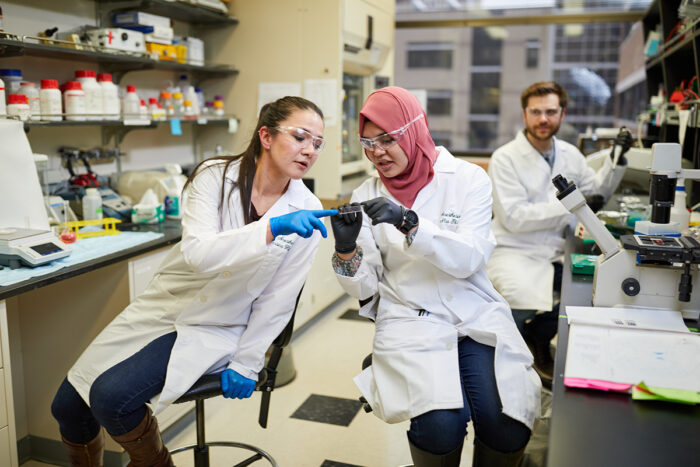 Matt Miller/WashU Medicine
WashU was ranked ninth among U.S. universities in the inaugural Cure Innovation Index, a national assessment of how effectively biomedical research institutions translate research into real-world impact.
Washington University in St. Louis is ranked among the top 10 universities in the inaugural Cure Innovation Index, a national assessment of how effectively biomedical research institutions translate scientific and clinical research into real-world impact.
WashU ranked ninth overall among 243 U.S. universities assessed. Each was evaluated in three categories: research capabilities, entrepreneurial readiness and market translation.
Among WashU’s strengths cited in the overall ranking were formal education programs that foster innovation and multifaceted institutional support available through the Office of Technology Management (OTM) and the Needleman Program for Innovation & Commercialization, which provides funding to develop promising therapies identified in the lab into medications that can be tested in clinical trials.
Of the individual categories evaluated, WashU ranked third in entrepreneurial readiness, which was based on institutional support for commercialization and the rate of participation of faculty and trainees in entrepreneurial activity. Educational programs such as WashU Medicine’s Medical Scientist Training Program for physician-scientists and the MD/MBA dual degree program offered through WashU Medicine and WashU Olin Business School contributed to the high ranking.
Furthermore, the Index noted that programs like OTM’s Entrepreneur in Residence, which provides mentoring and coaching to help faculty founders of start-up companies navigate the realities of entrepreneurship, fuels commercialization progress, as do links with business incubators like WashU’s integration with the Cortex Innovation District in St. Louis.
WashU’s world-class research facilities, combined with robust financial support of scholars and high-quality scientific output, landed the university as a national leader in the life sciences, ranking number five in research capabilities.
Among medical schools, WashU Medicine is the second-largest recipient of funding from the National Institutes of Health (NIH). The quality of science was measured by factors including citations; published clinical trials; awards such as the NIH’s High-Risk, High-Reward grants; number of Howard Hughes Medical Investigators; and faculty memberships in the National Academies of Sciences, Engineering and Medicine.
WashU ranked 19th in market translation, or how effectively an institution converts its research into real-world health innovations, as measured by indicators such as technology transfer, industry collaboration and patents. This high ranking reflects the record-setting $1.7 billion in private sector investment that WashU start-ups attracted last year.
Developed in consultation with academic, industry and government experts by Cure, a healthcare innovation ecosystem and commercial incubator in New York City, the Cure Innovation Index evaluated leading universities, research institutes and centers across all 50 states, Washington, D.C., and Puerto Rico. It drew on data from federal and commercial sources and surveys of more than 3,000 researchers and industry leaders.