Xie named newest BJC Investigator, inaugural David H. Perlmutter and Barbara A. Cohlan Distinguished Professor
Data scientist also leads WashU Medicine’s new Center for AI-Driven Precision Medicine
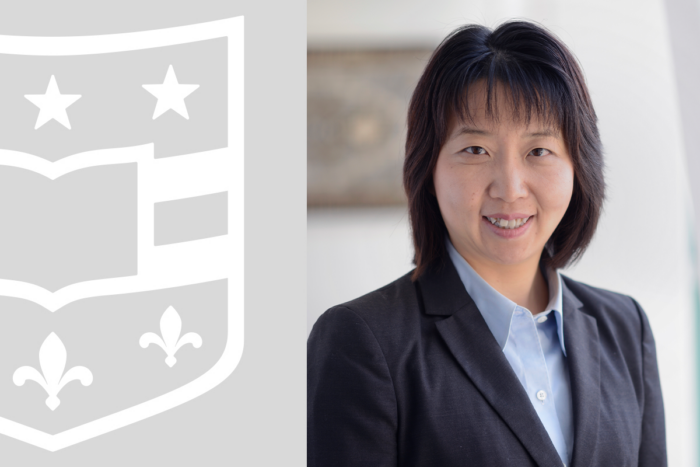
Yang Xie, MD, PhD
Yang Xie, MD, PhD, an international leader in advancing precision medicine via the innovative integration of biostatistics, clinical informatics and AI, has been named a BJC Investigator at Washington University School of Medicine in St. Louis. Xie recently joined the James S. McDonnell Department of Genetics as the inaugural David H. Perlmutter and Barbara A. Cohlan Distinguished Professor and serves as the inaugural director of WashU Medicine’s newly established Center for AI-Driven Precision Medicine.
Xie’s professorship was established by BJC HealthCare in honor of David H. Perlmutter, MD, who served as executive vice chancellor for medical affairs and dean of WashU Medicine for 10 years, and his wife Barbara A. Cohlan, MD, a professor of pediatrics at WashU Medicine. Perlmutter concluded his deanship in June.
“David and Barbara have devoted their careers to advancing science and medicine to improve the lives of patients, and it is fitting that a scientist of Yang Xie’s extraordinary talent will carry their names forward at WashU Medicine,” said Chancellor Andrew D. Martin. “Dr. Xie’s work reflects the kind of bold, interdisciplinary thinking that will shape the future of medicine — bringing together science, technology and clinical care in new ways to improve human health. We are deeply grateful to BJC HealthCare for making this professorship possible and for investing in the people and ideas that will define the next era of discovery.”
Xie is known for her research on computational and AI methods to improve precision medicine. Sometimes referred to as personalized medicine, precision medicine encompasses an approach to patient care that is tailored to an individual’s biology and genetics. Her body of work includes developing ways to understand how medications work in treating disease and using that insight to optimize therapeutic drug combinations and predict a patient’s response to treatments.
As director of the Center for AI-Driven Precision Medicine — sponsored by the Department of Genetics; the Institute for Informatics, Data Science & Biostatistics; and Siteman Cancer Center — Xie will lead the development and application of innovative AI technologies for biomedical research, drug discovery and improved patient care. Siteman, the only National Cancer Institute-designated Comprehensive Cancer Center in Missouri and southern Illinois, is based at Barnes-Jewish Hospital and WashU Medicine.
“Yang Xie’s pioneering work brings together artificial intelligence, computational biology and medicine to address some of the most challenging questions in human health,” said Bruce D. Levy, MD, executive vice chancellor for medical affairs, the Joseph Erlanger Distinguished Professor and the George and Carol Bauer Dean of WashU Medicine. “Her leadership of our new Center for AI-Driven Precision Medicine will help us harness the power of these technologies in ways that deepen our understanding of disease, accelerate discovery and define the future of precision medicine.”
Launched by Perlmutter in 2017, together with a search committee that included 48 WashU Medicine faculty members, among them some of the top medical scientists in the world, the BJC Investigators Program brings visionary scientists to WashU Medicine — researchers who can have a transformational impact on research programs, drive innovative approaches to major biological questions and inform new ways of understanding disease. The program was made possible by funding of $100 million from BJC HealthCare with the bold aspiration from then-BJC CEO Steven Lipstein that it would strengthen WashU Medicine in the basic sciences by attracting the most talented and innovative investigators from around the country to St. Louis.
“Our family is deeply grateful to BJC HealthCare and WashU Medicine for recognizing Barbara and me in this way,” Perlmutter said. “We have long been inspired by the power of the personalized, or precision, medicine paradigm and how it exemplifies ‘the virtuous cycle of academic medicine.’ We are also thrilled that Yang Xie will be the first to hold the professorship as she works in advancing that paradigm through the newest AI-driven technologies. It was a special treat to play a role in her recruitment as a BJC Investigator.”
The BJC Investigators program is inspired by the Howard Hughes Medical Institute’s philosophy of investing in scientists with exceptional creative talent. The goal is to bring 10 highly regarded researchers to WashU Medicine and the life sciences ecosystem in St. Louis. Xie is the ninth BJC Investigator named.
BJC Investigators are recommended by a search committee of leading scientists at WashU Medicine. The committee is charged with selecting candidates who have indelibly changed their fields, whose discoveries will result in new and fundamental shifts in scientific thinking, and whose laboratories have become hubs for work that can galvanize and advance the impact of WashU Medicine’s preclinical departments.
“BJC’s investment in AI-powered health research at WashU Medicine reflects our commitment to advancing care that is more precise, more effective and better tailored to each patient’s needs in every moment,” said Nick Barto, president and chief executive officer of BJC Health. “Dr. Xie’s progress in precision medicine has the potential to deepen clinicians’ understanding of disease at the level of the individual and improve outcomes across the communities we serve.”
Xie came to WashU Medicine from the University of Texas Southwestern Medical Center in Dallas, where she was the founding interim chair of the Department of Health Data Science and Biostatistics and served as associate dean for data science.
As the principal investigator of a Maximizing Investigators’ Research Award (MIRA), funded by the National Institutes of Health (NIH), Xie develops approaches that integrate molecular information about cancer with pharmacologic data to predict how tumors will respond to single drugs and drug combinations — allowing vast combinations of candidate therapies to be screened computationally. The technique allows the most promising multi-drug regimens to be prioritized for experimental validation. This research addresses a defining bottleneck in precision oncology: The number of possible drug combinations far exceeds what any laboratory can test. Xie’s recent computational models help identify binding targets and binding sites of small molecules, improving the understanding of how different drug compounds work and opening new avenues for drug repurposing and optimization.
Xie’s group has built AI systems to analyze structured genomics, digital pathology and spatial biology, and developed models to optimize the balance of efficacy versus toxicity of cancer immunotherapy. Pushing the frontier of the field, her team also has developed AI models that autonomously plan and execute complex research workflows.
“Yang brings a remarkable breadth of expertise that will complement and expand the work already underway in Genetics,” said Ting Wang, PhD, the Sanford C. and Karen P. Loewentheil Distinguished Professor of Medicine and chair of the James S. McDonnell Department of Genetics. “Her ability to integrate genomic data, computational methods and clinical information will create new opportunities to understand disease and translate those insights into more precise approaches to prevention and treatment.”
Xie earned her medical degree from Peking University in 1997 and a master’s degree in epidemiology at the Chinese Academy of Medical Sciences & Peking Union Medical College in 2000. She continued her studies at the University of Minnesota, Twin Cities, where she earned a master’s degree in biostatistics in 2002 and her doctoral degree in biostatistics in 2006. Later that year, she was recruited to join the faculty of UT Southwestern Medical Center.
Among the most productive and influential data scientists in academic medicine, Xie’s publications have been cited more than 25,000 times. Her work has been consistently funded by the NIH, and her inventions have led to five patents or patent applications.