

$11.7 million from NIH supports research on inflammation in blood cancers
Grant will fund four major projects, three core resources to study myeloproliferative neoplasms
 Oh Lab
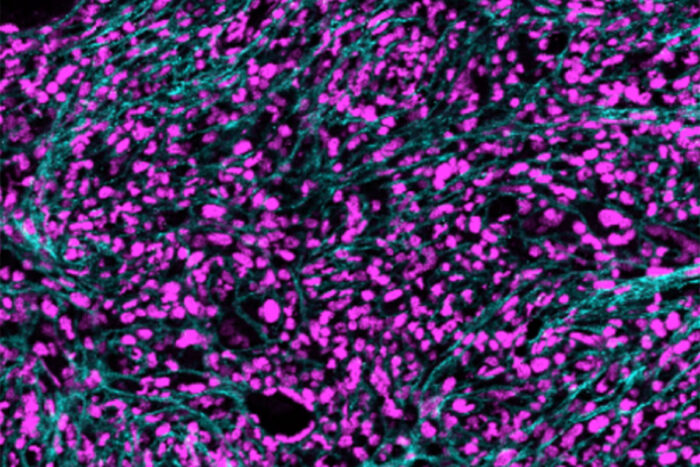
A new NIH grant to WashU Medicine supports research into myeloproliferative neoplasms (MPNs), a group of blood cancers. In an MPN called myelofibrosis, reticulin fibers (in cyan) infiltrate the bone marrow.
In Brief
- The NIH has awarded WashU Medicine investigators an $11.7 million grant to study how inflammation drives myeloproliferative neoplasms, a group of blood cancers at high risk of progressing to acute myeloid leukemia.
- The grant funds four research projects each examining different inflammatory pathways to develop a better understanding of the disease in pursuit of new therapies.
- The funding also supports three shared core resources for administration, biospecimen and pathology work, and bioinformatics.
Researchers at WashU Medicine have received an $11.7 million grant from the National Heart, Lung, and Blood Institute of the National Institutes of Health (NIH) to study the role of inflammation in myeloproliferative neoplasms (MPNs), a group of blood cancers characterized by an overproduction of red blood cells, white blood cells or platelets.
The WashU Medicine investigators are research members of Siteman Cancer Center, based at Barnes-Jewish Hospital and WashU Medicine, and include physician-scientists who treat patients at Siteman.
MPNs can be slow to progress, and patients can survive years or decades, but they are also at high risk of developing acute myeloid leukemia (AML), an aggressive blood cancer with limited treatment options and poor survival. A stem cell transplant can in some cases achieve remission, but few patients qualify for it because of advanced age or overall health.
Other current treatments improve MPN symptoms — such as unintended weight loss, night sweats, fatigue and an enlarged spleen that often causes pain — but they can’t slow the progression of the disease or reduce the risk of it transforming to AML. As such, there is a critical need to understand how the disease starts and evolves in order to guide development of better therapies for patients. In recent years, inflammation has emerged as a critical component driving these blood cancers.
The grant supports four major research projects and three new core resources that will provide shared resources to the investigators.
“This funding supports a true team-science effort because all four projects look at inflammation, but each in a different way,” said principal investigator Stephen T. Oh, MD, PhD, the Samuel B. Grant Professor of Clinical Medicine and co-director of WashU Medicine’s Division of Hematology. “Together, they will give us a more complete picture of how MPNs behave. If we understand the biology of the diseases more deeply, we can lay the groundwork for translating basic research into improved therapeutics that may one day change the course of these diseases.”
Four projects investigating inflammation in blood cancers
The first project, led by Oh, will harness mouse models and human samples to understand how two cellular molecules that interact with one another — DUSP6 and RSK1 — drive inflammation and whether blocking their downstream effects can reduce the inflammatory signaling in or around the cancer cells and stop MPNs from progressing. RSK inhibitors are already under investigation in cancer patients, primarily for breast cancer but also for MPNs, including in a clinical trial at Siteman that is separate from this new grant and led by Amy W. Zhou, MD, an associate professor of medicine.
The second project, led by Grant A. Challen, PhD, a professor of medicine in the Division of Oncology, will investigate how inflammation produced by MPN cells influences the function of other stem cell clones in the bone marrow. Some MPN patients manifest a secondary leukemia descended from mutated stem cells that develop in parallel to the patients’ primary MPN disease. This project will look at how MPN-derived inflammation might govern which clones gain growth advantages in these patients and how they might interact with one another to accelerate the disease.
The third project, led by Daniel C. Link, MD, the Alan A. and Edith L. Wolff Professor of Medicine, chief of the Division of Oncology and deputy director of Siteman, will probe drivers of inflammation in the bone marrow to understand how it may boost or interfere with MPN progression. The project involves sophisticated spatial imaging to build maps of how MPN cells interact with the bone marrow environment, seeking clues to how those interactions may drive disease.
The fourth project, led by Jorge A. Di Paola, MD, who began this work as a professor of pediatrics at WashU Medicine, will focus on interfering with the activity of a molecule called TNFalpha that is often elevated in MPN patients. It is an inflammatory molecule known to increase the risk of blood clots, which are a leading cause of health complications and death among these patients. Di Paola is continuing this project in his new roles as director of the Versiti Blood Research Institute and associate dean of research at the Medical College of Wisconsin.
The grant also supports three core research facilities, which provide shared resources for the entire team, including an administrative core, led by Oh; a biospecimen and pathology core, led by Mark Watson, MD, PhD, the Margaret Gladys Smith Professor of Pathology and Immunology; and a bioinformatics and biostatistics core, led by Obi L. Griffith, PhD, a professor of medicine in the oncology division.
Oh credits institutional support for the group’s early research from WashU Medicine and Siteman as key to receiving the new NIH grant. That support included a Siteman Cancer Center Team Science Award and additional support from the John T. Milliken Department of Medicine, Division of Oncology, Division of Hematology, Department of Pediatrics, Siteman, and the McDonnell Pediatric Cancer Research Center.