
Scientists identify brain’s brake that shuts off chronic pain
Finding from mouse study could lead to targeted treatments for chronic nerve pain
 Chao-Cheng Kuo
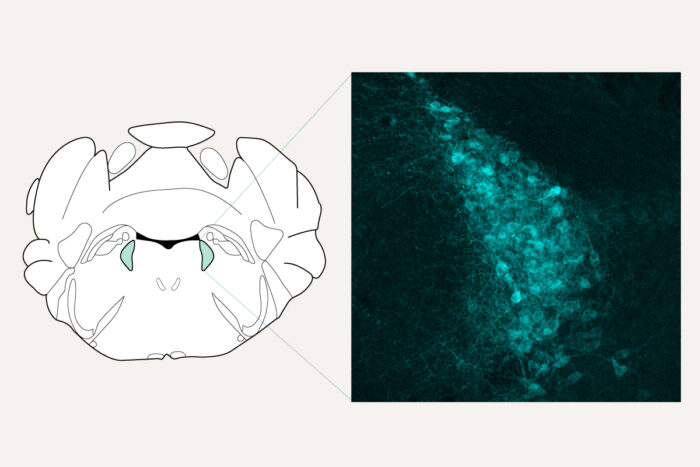
A cluster of nerve cells (cyan, right) in the mouse brain (cyan, left) play a role in both pain relief and the generation of chronic pain. WashU Medicine researchers found that certain receptors on the surface of these cells can shut off chronic pain.
Deep at the base of the brain, a tiny cluster of nerve cells serves as the body’s natural pain reliever, dialing down pain signals traveling up the spinal cord. But nerve damage can flip this system into a hyperactive engine for chronic pain.
Now, researchers at Washington University School of Medicine in St. Louis have figured out why that switch flips, and how to shut it off. They identified, in mice, that certain receptors that reside on the surface of cells in the brain’s main alert and stress center act as biological brakes on pain. Previously known to influence stress in this region of the brain, these receptors also can turn off the pain engine to relieve chronic neuropathic pain following nerve injury.
The study, published Aug. 17 in Current Biology, opens new doors for developing therapies that specifically target this region of the brain, known as the locus coeruleus, to reduce chronic pain.
“Millions of adults live with chronic neuropathic pain caused by nerve damage,” said Jordan McCall, PhD, an associate professor in the Center for Clinical Pharmacology in the WashU Medicine Department of Anesthesiology and the study’s senior author. “The pain is difficult to treat, and traditional opioid medications bind to receptors throughout the entire body and brain, often leading to side effects, tolerance and addiction risk. Understanding how localized receptors in the locus coeruleus act as gatekeepers could lead to more targeted, effective pain therapies with fewer risks.”
A brake on pain
Neuropathic pain occurs when damaged nerve fibers send relentless, misfired signals to the brain, causing shooting, stabbing or burning sensations. The condition frequently stems from diabetes, viral infections or nerve compression, among other factors.
To understand how to stop these signals, McCall’s team, including co-first authors Chao-Cheng Kuo, PhD, a postdoctoral research associate, and Makenzie R. Norris, a former graduate student, focused on the locus coeruleus, a part of the brain that has been shown to play a role in pain regulation.
First, they confirmed that nerve injury turns this region into an active driver of pain. When they temporarily turned off locus coeruleus brain cells in mice, they observed reduced sensitivity to touch and heat among animals modeling neuropathic pain compared with healthy mice.
Next, they turned their attention to receptors on locus coeruleus brain cells that respond to opioids, and in particular, a type of opioid receptor known as mu. Mu opioid receptors are scattered throughout the brain and spinal cord. When the body’s naturally produced opioids or synthetic ones such as morphine and fentanyl land in the receptors’ pockets, pain throughout the nervous system lessens. Because the locus coeruleus is packed with these receptors, the researchers wondered if they play an important role in pain regulation.
They deleted the mu opioid receptors on only the locus coeruleus brain cells in mice with neuropathic pain. Without the receptors, the mice were even more sensitive to touch and heat compared with mice with mu opioid receptors still present in the locus coeruleus. Restoring the receptors to those same neurons reversed the hypersensitivity, effectively turning the pain off.
The result indicates that chronic pain may be impairing the ability of mu opioid receptors to tamp down the activity of brain cells in the locus coeruleus. Building on these findings, the researchers are exploring how to manipulate the locus coeruleus without affecting receptors across the rest of the nervous system. By designing therapies that specifically engage mu opioid receptors in this brain region, the researchers said they hope to pave the way for treatments that offer powerful relief for chronic neuropathic pain.