
WashU Medicine and Barnes-Jewish Transplant Center perform breakthrough robotic liver-kidney transplant
Innovative procedure extends minimally invasive transplantation to patients requiring both organs
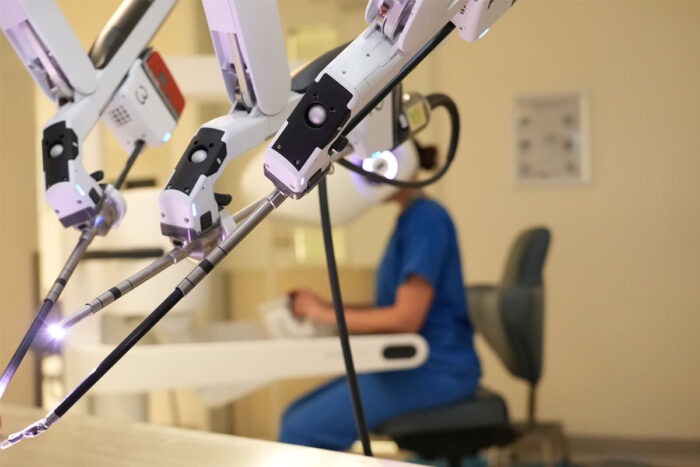 Courtesy BJC HealthCare
A surgical team has performed the world’s first-reported robotic double transplant of a liver and kidney at WashU Medicine and Barnes-Jewish Transplant Center.
A surgical team at WashU Medicine and Barnes-Jewish Transplant Center has performed the world’s first-reported robotic combined liver and kidney transplant, extending the benefits of minimally invasive transplant surgery to a patient in need of both organs.
Robotic transplantation has previously been performed successfully for separate kidney transplants and liver transplants. In 2020, WashU Medicine surgeon Adeel Khan, MD — a pioneer in the field of robotic surgery who helped advance its use to abdominal organ transplantation — performed one of the first robotic kidney transplants in the United States at Barnes-Jewish Hospital. In 2023, he performed the country’s first robotic liver transplant at Barnes-Jewish.
This latest clinical advancement led by Khan and Jessica Lindemann, MD, PhD, an assistant professor of surgery at WashU Medicine, demonstrates that a robotic approach also may be feasible for carefully selected patients who need multiple organs transplanted.
Darrell Bosworth of Martinsburg, Mo., underwent the combined robotic liver-kidney transplants in May of this year after developing failure of both organs as a result of advanced liver disease and cirrhosis.
“Patients who require simultaneous liver and kidney transplantation are often among the sickest and most fragile patients we care for,” Khan said, noting that traditional open surgery can be particularly hard on such patients. “Their bodies are already under tremendous physiologic stress after months or years of advanced organ failure. Our goal with Darrell was to perform both transplants safely while minimizing the physical and psychological impact of surgery, giving him the best possible opportunity for a faster and smoother recovery.”
Trusting the expertise at WashU Medicine and Barnes-Jewish Hospital
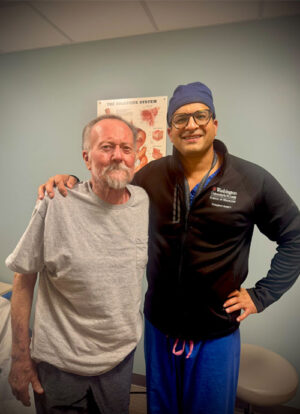 Courtesy Kim Bosworth
Bosworth lives in a small town about two hours west of St. Louis. About a year and a half before his transplant, his family noticed that his skin and eyes had developed a yellow tinge. He started seeing Parth Shah, MD, an assistant professor of medicine and WashU Medicine liver specialist who treats patients at Barnes-Jewish Hospital. Bosworth ultimately was diagnosed with liver cirrhosis and kidney failure.
The two-hour drives to the city were worth it, said his wife, Kim Bosworth, who understood that her husband eventually might require highly specialized care.
“I wanted all our doctors in one place, and I knew Barnes-Jewish and WashU Medicine was the place to be,” she said.
As Bosworth’s liver disease progressed, it began affecting his kidney function as well — not uncommon in severe liver disease, which can impair blood flow to the kidneys and lead them to fail. WashU Medicine and Barnes-Jewish Transplant Center performs around 20 combined liver and kidney transplants a year.
By May 2026, Bosworth had lost approximately 70 pounds and was largely confined to bed. He required dialysis and frequent procedures to remove fluid that had accumulated in his abdomen. He also experienced worsening episodes of confusion related to his liver disease.
With his condition deteriorating, the Bosworths drove to Barnes-Jewish, where Darrell was admitted and subsequently placed on the transplant waiting list. Given his condition and the team’s experience in robotic liver and kidney transplantation, Khan and Lindemann believed Bosworth could benefit from a minimally invasive approach for the double transplant.
“I had complete trust in our team and in Dr. Khan and in whatever he was going to do,” said Darrell Bosworth. “We had visited with him quite a bit, so that trust is what we went by.”
Experience combined with a careful plan
Although Khan and Lindemann had extensive experience with robotic transplantation, performing two organ transplants in the same patient required meticulous planning.
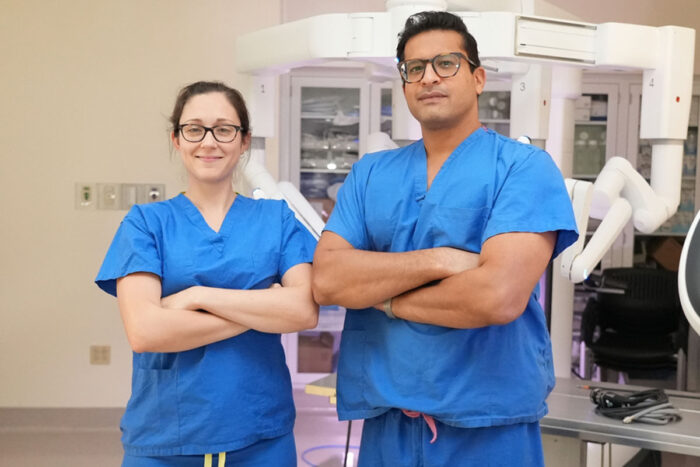 Courtesy BJC HealthCare
“The liver transplant portion is the more complicated surgery, and we carefully worked through every step of both operations,” said Lindemann. “We were very deliberate about the sequence of the operations, how we would use the robotic approach and how the entire team would work together so each step could be performed safely and efficiently.”
The opportunity came quickly — a donor kidney and liver became available in late May, three weeks after Bosworth was placed on the transplant list.
The team performed the liver transplant first in an operation lasting just over eight hours. Khan operated from the robotic surgical console, controlling the robotic instruments while viewing the operative field through a highly magnified 3D display. Lindemann worked as the bedside surgeon, providing manual support and access to the needed areas during critical portions of the operation.
Khan and Lindemann removed the original liver and transplanted the donor liver through a single incision of roughly 3 inches and connected the key blood vessels and bile ducts through smaller secondary incisions. In contrast, traditional open abdominal surgery typically involves a 16- to 20-inch incision and requires cutting through most of the abdominal muscles.
The following morning, Bosworth’s new liver was functioning well, and the team returned to the operating room to perform the kidney transplant. Using the same incisions through which the liver transplant had been performed, Khan and Lindemann completed the robotic kidney transplant in just over half the time the liver transplant took.
Khan and Lindemann attached the blood vessels to the new kidney and watched it turn a healthy pink color and start producing urine a few minutes later — a strong sign of a successful kidney transplant operation.
The road to recovery and an open future
Bosworth said he experienced remarkably little postoperative pain.
Both organs started working immediately after transplant, and by the 10th day after surgery, his mental clarity had improved significantly and he had excellent function of the transplant organs. Within two weeks of surgery, he was able to climb a short flight of stairs. With his strength improving, he is now able to move around independently with the aid of a walker.
For Khan, the case is more than a milestone: “It reflects years of experience, team development, and a thoughtful and deliberate commitment by WashU Medicine and Barnes-Jewish Hospital to advance surgical innovation in a safe and rigorous way,” he said. “That infrastructure allows us to consider approaches for our patients that would not otherwise be possible. Our hope is that, over time, these approaches will allow more transplant patients to benefit from less invasive surgery and an easier recovery.”