Stallings, Philips and collaborators to study evolution of tuberculosis
$12.6 million NIH grant supports examination of how the immune system, antibiotics and other diseases push the bacterium to adapt
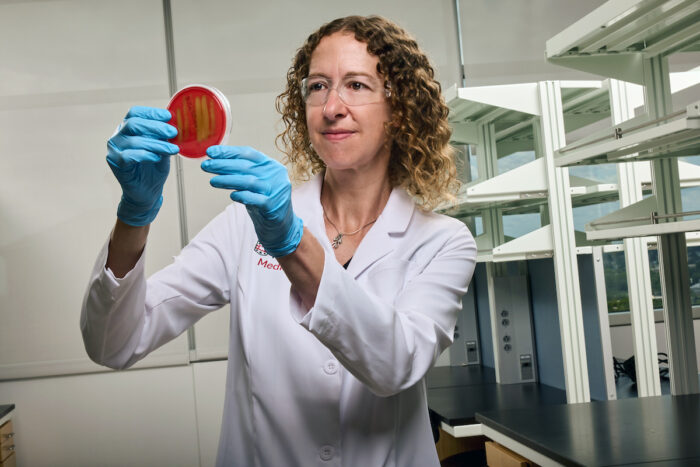 Matt Miller/WashU Medicine
Christina Stallings, PhD, and colleagues at WashU Medicine won a $12.6 million federal grant to study tuberculosis (TB), the world’s deadliest infectious disease. The team will look at why some TB strains get past the body’s defenses, survive antibiotics or spread more easily, including in people with HIV or diabetes, to help find better treatments.
In Brief
- WashU Medicine scientists received a $12.6 million federal grant to study tuberculosis (TB), the world’s deadliest infectious disease.
- They will investigate why certain TB strains spread, dodge the body’s defenses or survive antibiotics, including in people with HIV or diabetes.
- Findings could improve treatment and prevention.
Christina Stallings, PhD, and Jennifer Philips, MD, PhD, both Theodore and Bertha Bryan Professors of Environmental Medicine at WashU Medicine, and their collaborators received a five-year, $12.6 million grant from the National Institute of Allergy and Infectious Diseases, part of the National Institutes of Health (NIH). The award supports a multi-institutional research program investigating how Mycobacterium tuberculosis keeps adapting to the people it infects, despite the best attempts of antibiotics and the immune system to thwart it. Understanding the bacterium’s evolution could support the development of new treatment and prevention strategies.
Tuberculosis (TB) remains the world’s deadliest infectious disease, with an estimated 10.7 million cases and 1.2 million deaths annually. It has evolved alongside humans continuously, with the bacterium finding ways to cause disease and the human immune system finding ways to fight back. The development of antibiotics introduced a new pressure against TB, and the bacterium adapted to that, too.
“Tuberculosis has been with humans forever, and it’s still a major deadly infection,” Stallings said. “This project is looking at what’s happening now in people with tuberculosis. What strains of bacteria are causing disease, and why have they emerged? Then, can we use that information to better treat these infections?”
The project brings together collaborators with expertise in disciplines ranging from bacterial genome evolution to antibiotic tolerance to immunology, including Dmitri Kotov, PhD, and Priya Pal, MD, PhD, both assistant professors of medicine in WashU Medicine’s Division of Infectious Diseases, and six other institutions.
By mining genetic sequences from TB strains collected from sick patients around the world, the team has already identified the specific variants that turn up most often in the clinic. Now, they aim to find out why. Are those variants better at getting past a person’s immune response, better at withstanding a six-month course of antibiotics, or better at spreading from one person to the next? Figuring out how TB succeeds will help enable more targeted treatment.
The research program includes studies that focus on how TB changes in patients with HIV or diabetes, conditions that raise TB risk. Philips leads the HIV project. She will investigate whether certain bacterial variants thrive or falter in people living with HIV, who are more susceptible to TB even when the virus is well controlled. Stallings is taking the same approach to diabetes.
Led by Makedonka Mitreva, PhD, the Gordon R. Miller Professor of Medicine at WashU Medicine, a dedicated bioinformatics core will conduct advanced analyses of multi-modal data, including bacterial genetics and physiology and human immune responses. It leverages a cloud-based data sharing and analytics platform developed by the WashU Medicine Institute for Informatics, Data Science & Biostatistics.
“Putting together all the parts to profile the bacteria on multiple levels, profile the host immune response, incorporate these co-existing conditions and then integrate all that data is only possible because of the team we put together,” Stallings said. “No single person would be able to do this on their own.”